FIG 1. REFINEAT Project

Overview
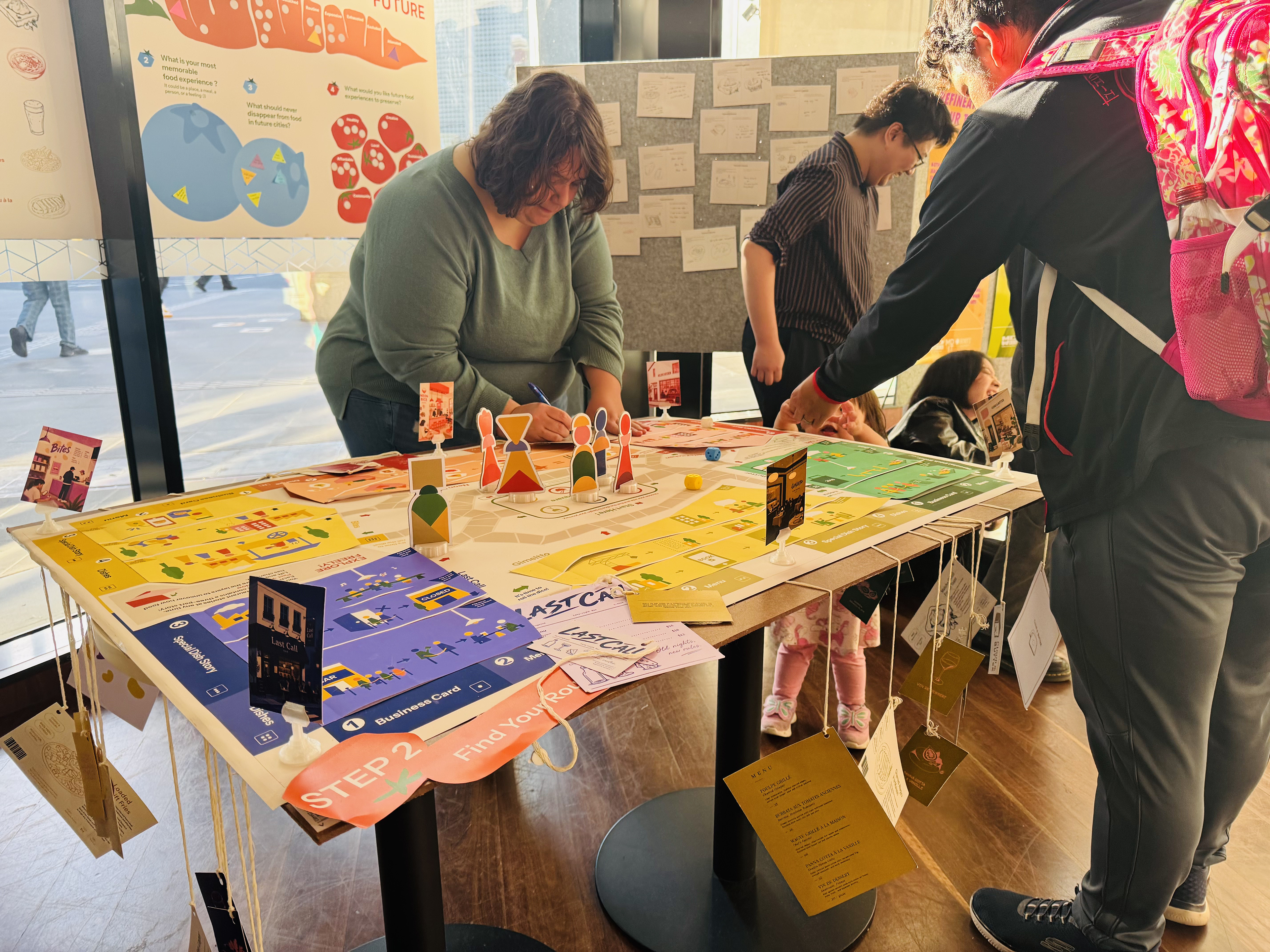
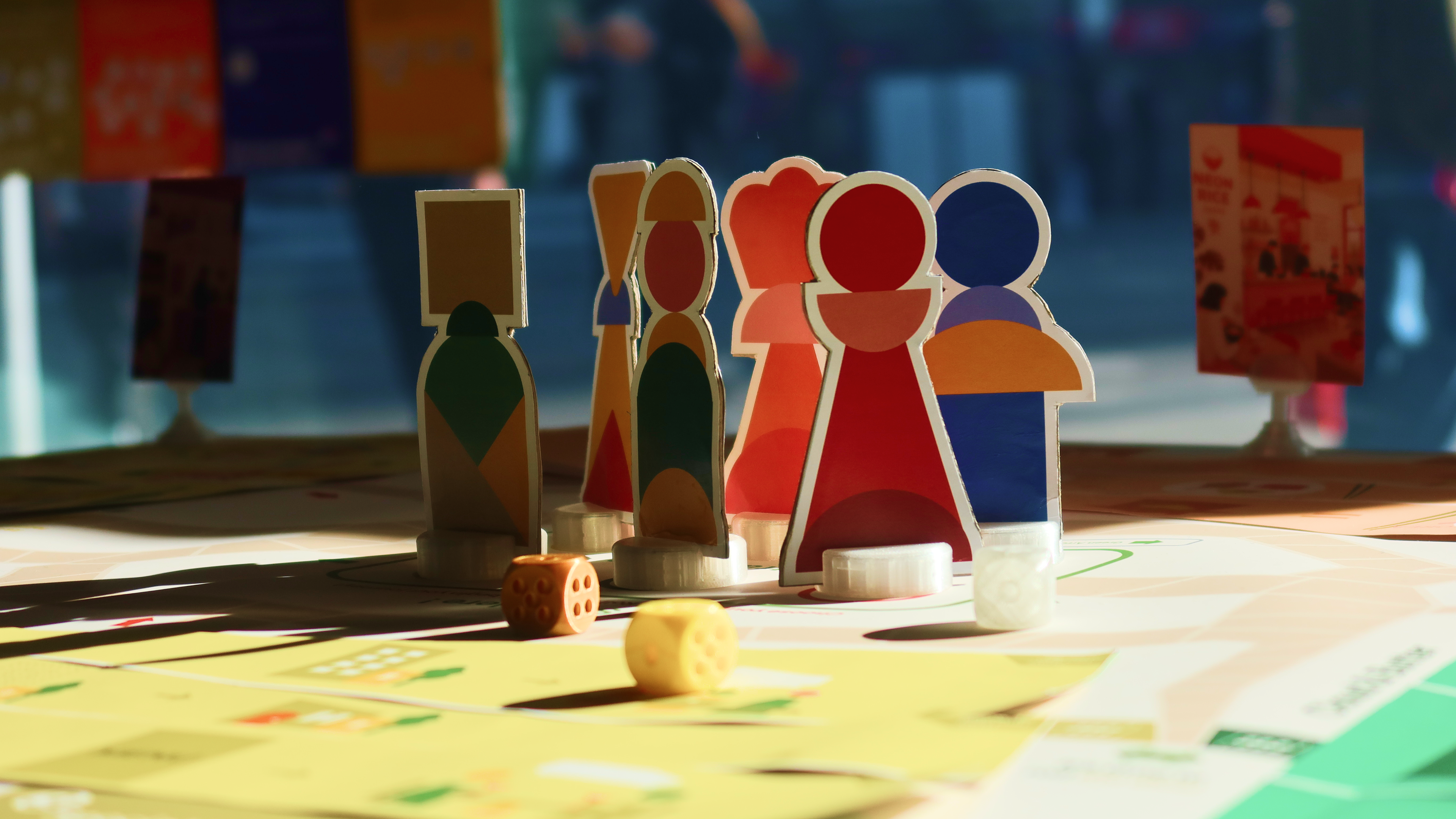
REFINEAT: Your Taste Cost is an interactive experience that reveals the hidden social impact of everyday dining choices in Melbourne. Through role-playing missions, restaurant stories, and map-based exploration, participants uncover how food spaces change over time and how their own decisions contribute to that change.
Presented at Melbourne Design Week 2026, the project translates research on food gentrification into a participatory experience, helping people understand a complex urban issue through exploration, reflection, and discussion.
Timeline
Mar 2026 - Jun 2026, 3 months

Outcome
Team
Jackie Xie — Lead Designer
User Research, UX Design, Graphic Design, Prototyping, Usability Test
Sharon Xu — UX Designer
User Research, UX Design, Graphic Design, Prototyping, Usability Test
00 HIGHLIGHTS​​​​​​​
Transforming a complex social issue into an interactive experience that encourages reflection rather than providing answers.

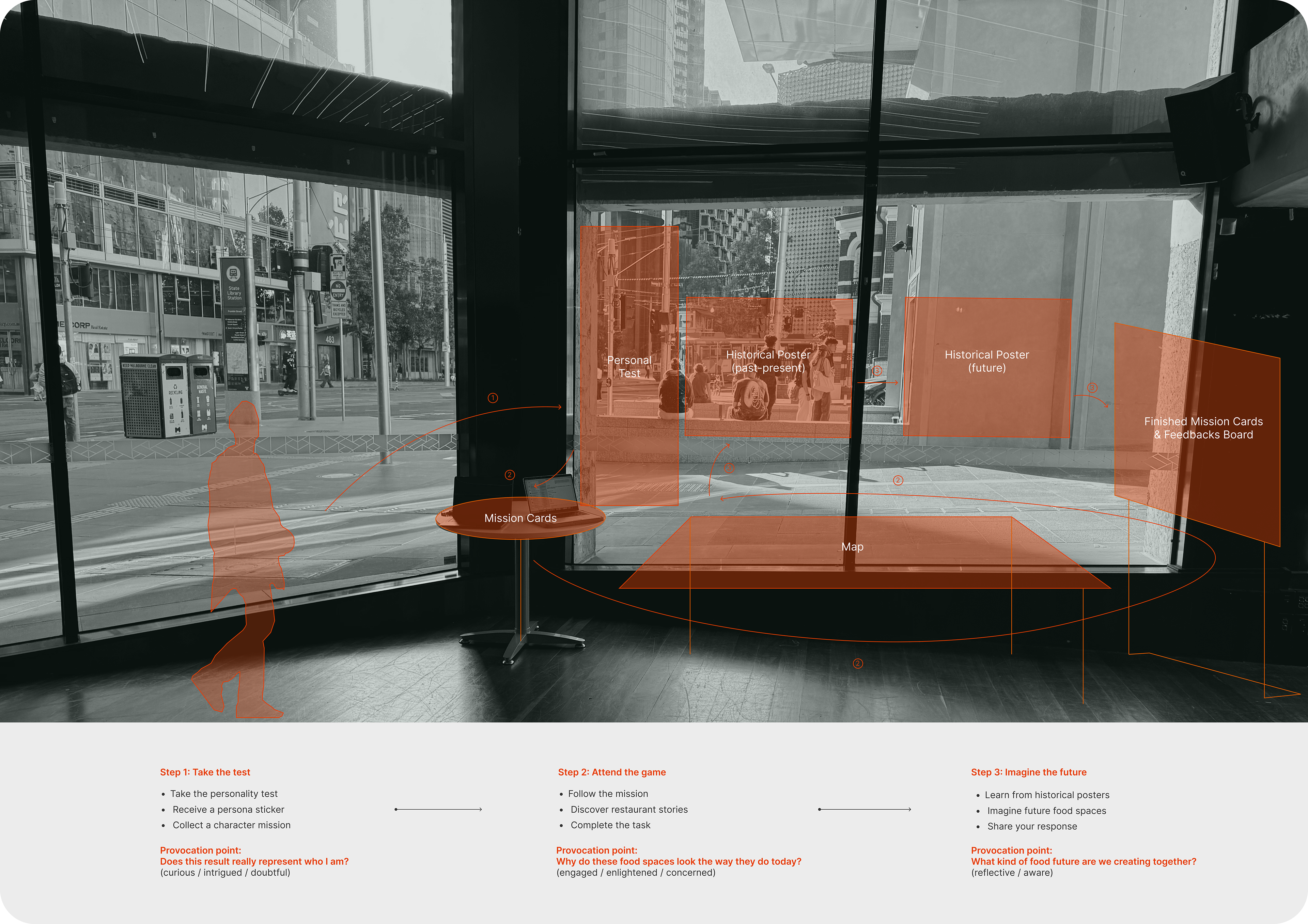
FIG 2. Experience Map

FIG 3. The Whole Experience System
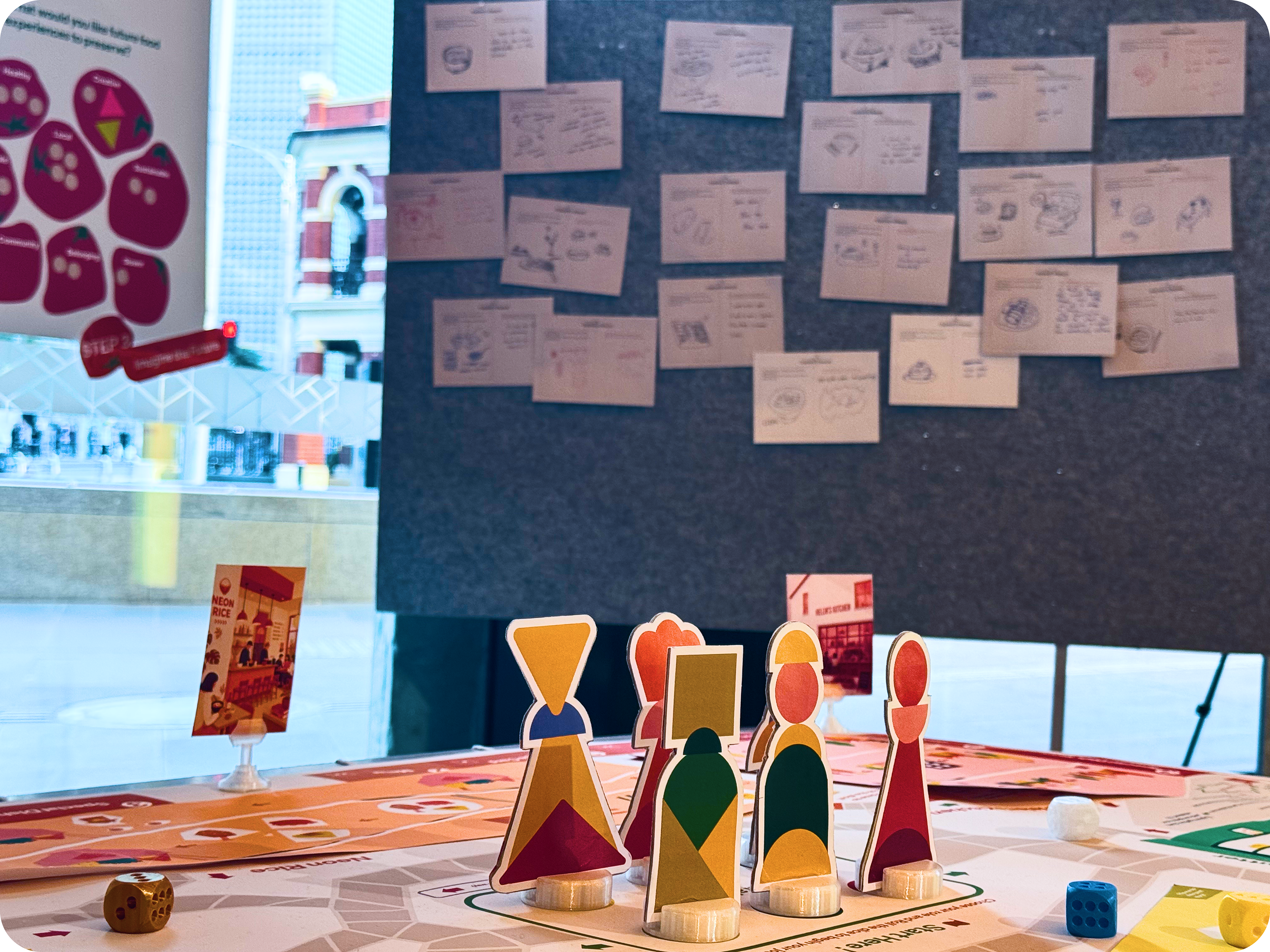
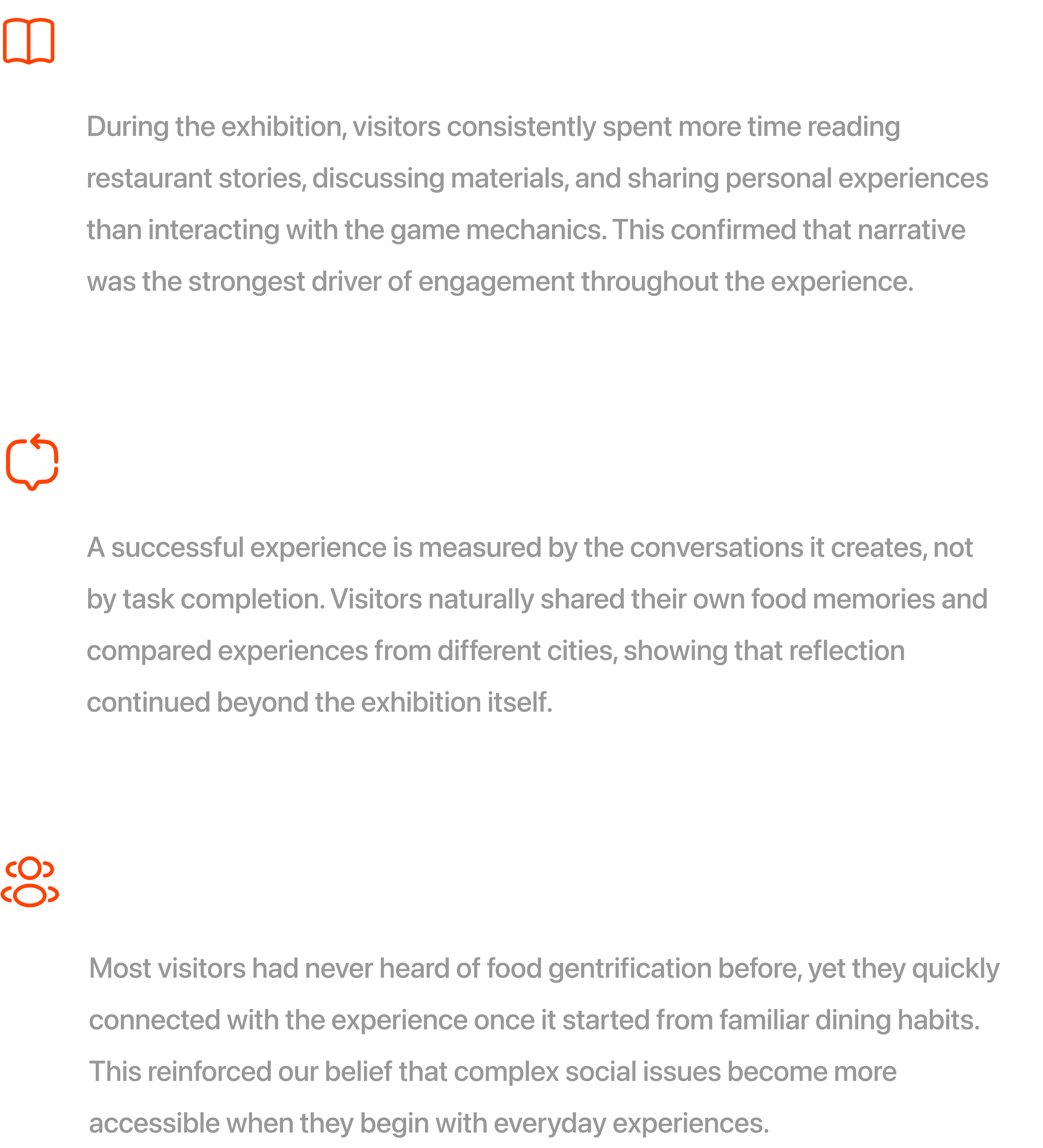
FIG 4. Experience Feedback from Visitors

01 CONTEXT
What's Food Gentrification?
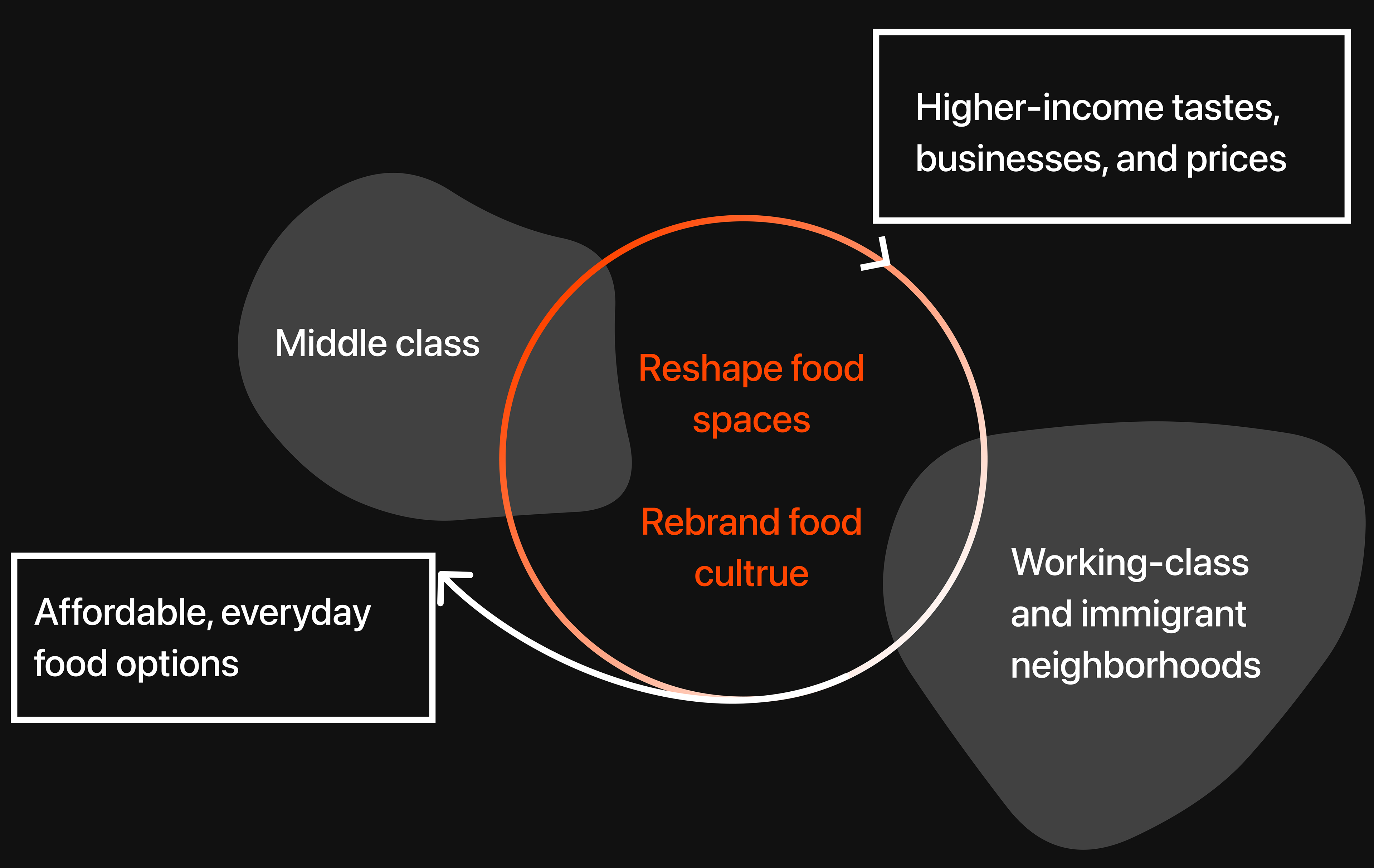
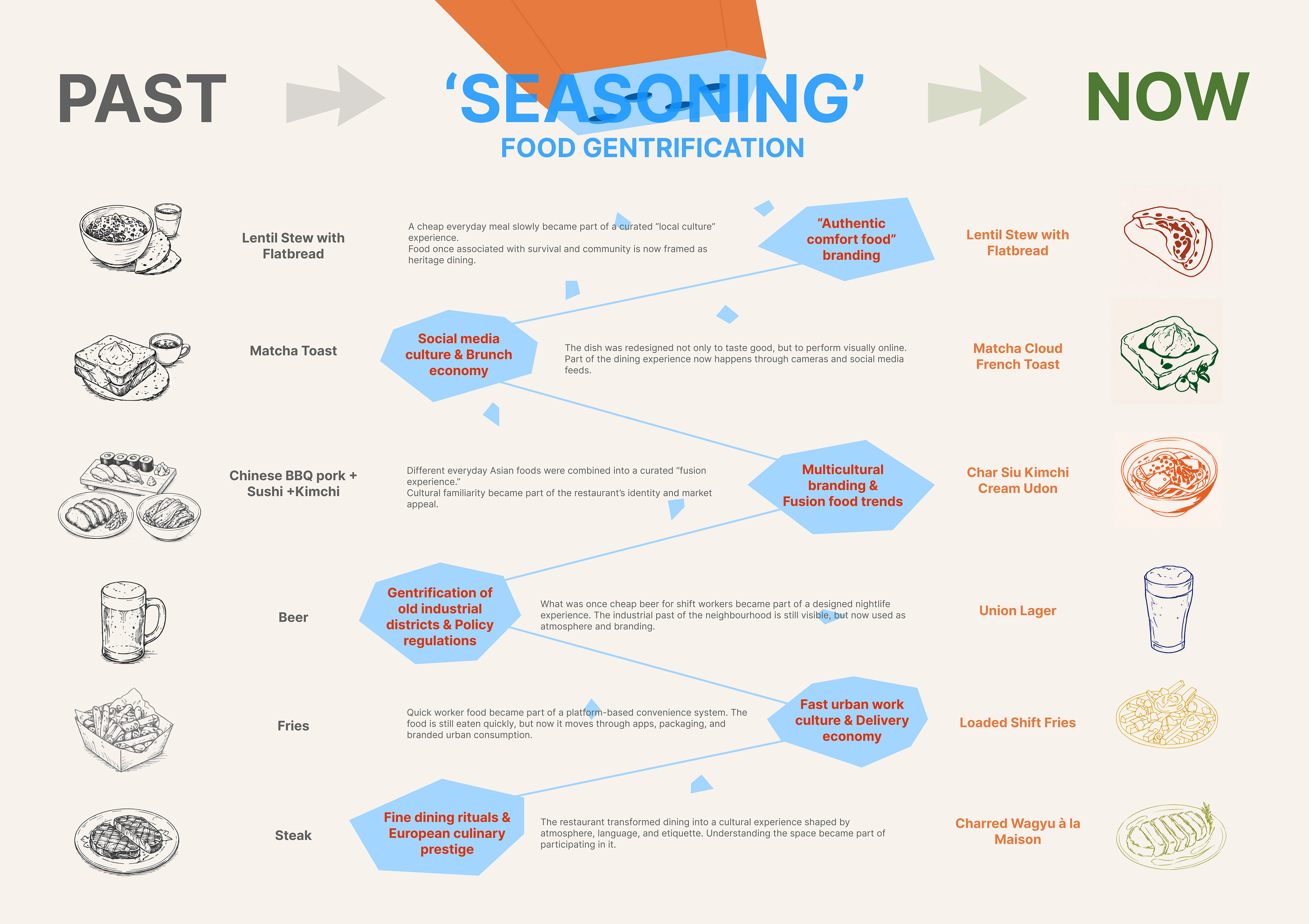
Melbourne’s food system is historically rooted in colonial structures, where food consumption has been used to reinforce class and cultural hierarchies. When more affluent and highly educated middle-class groups moved into working-class neighbourhoods, local food cultures were gradually reinterpreted, aestheticised, and commercialised. Food shifted from survival to identity and lifestyle (FIG.7,8). This process was called food gentrification (FIG.5). Meanwhile, digital platforms, and changing cultural aesthetics all contribute to the process. Food gentrification is now happening both on the street and on our screens (FIG.6). The food spaces we love are constantly changing. But how often do we consider our own role in shaping those changes?

FIG 5. Food Gentrification Principle Diagram
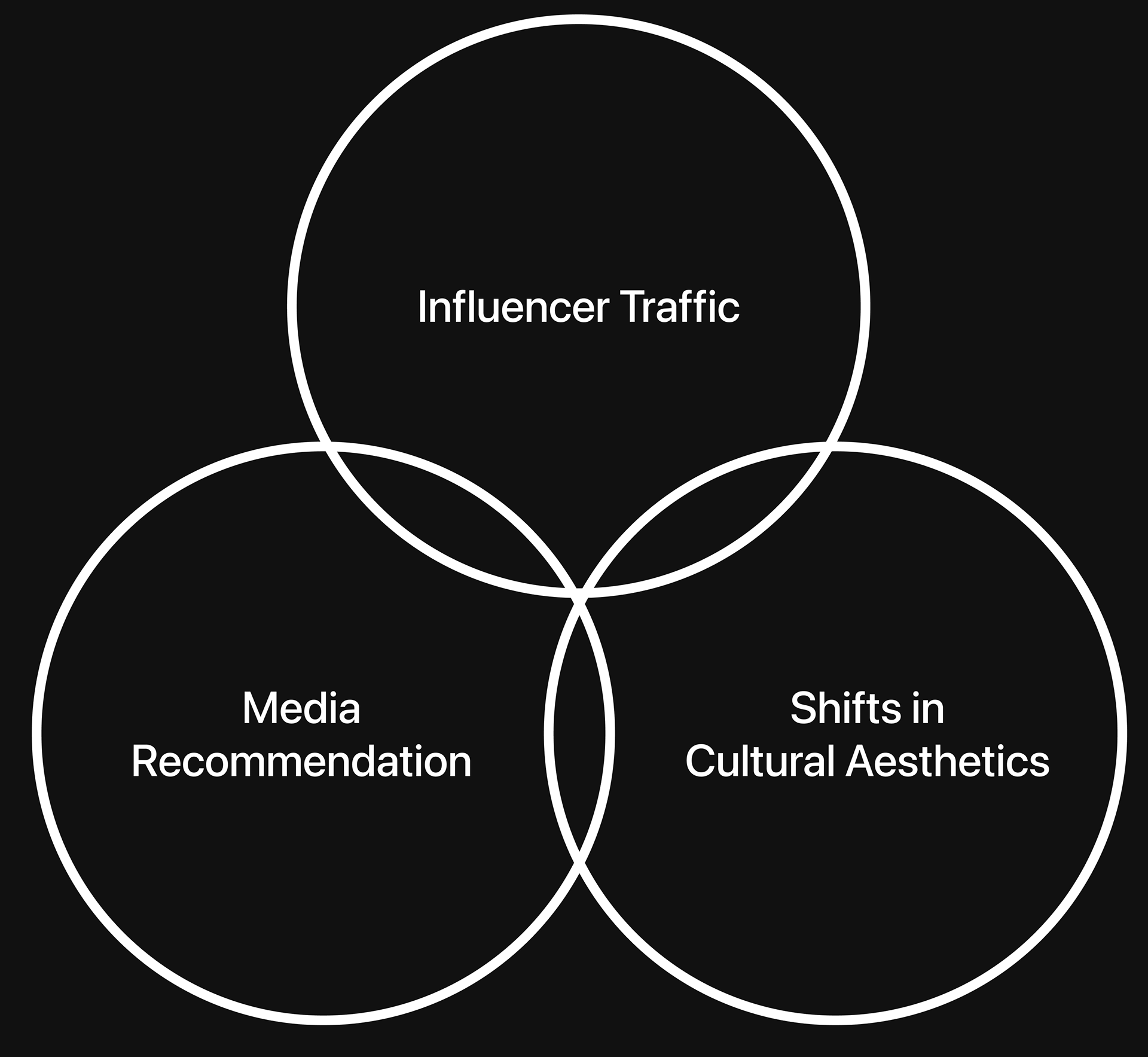
FIG 6. Modern Food Gentrification Factors
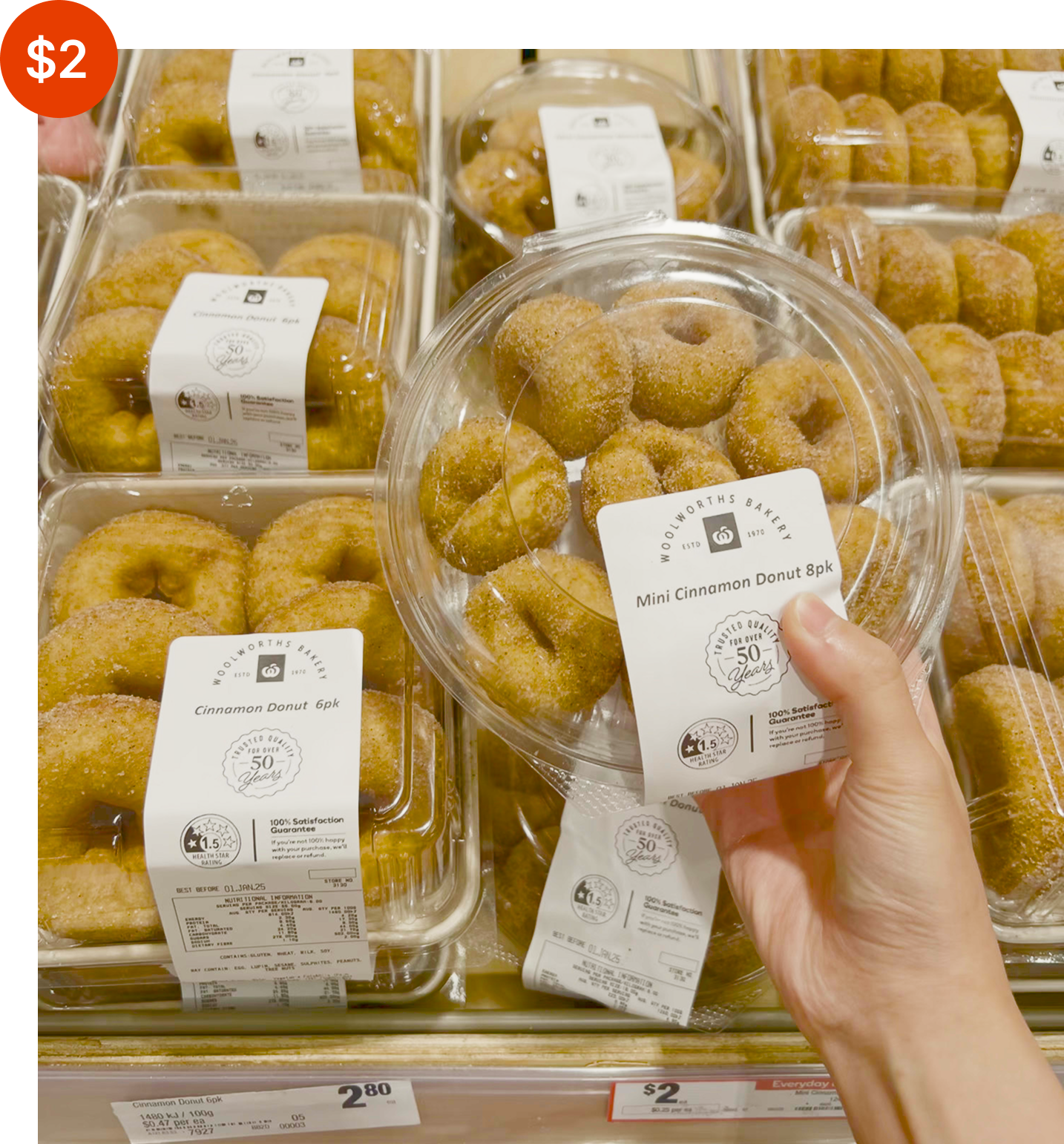
FIG 7. Food as Survival & Community (Before)
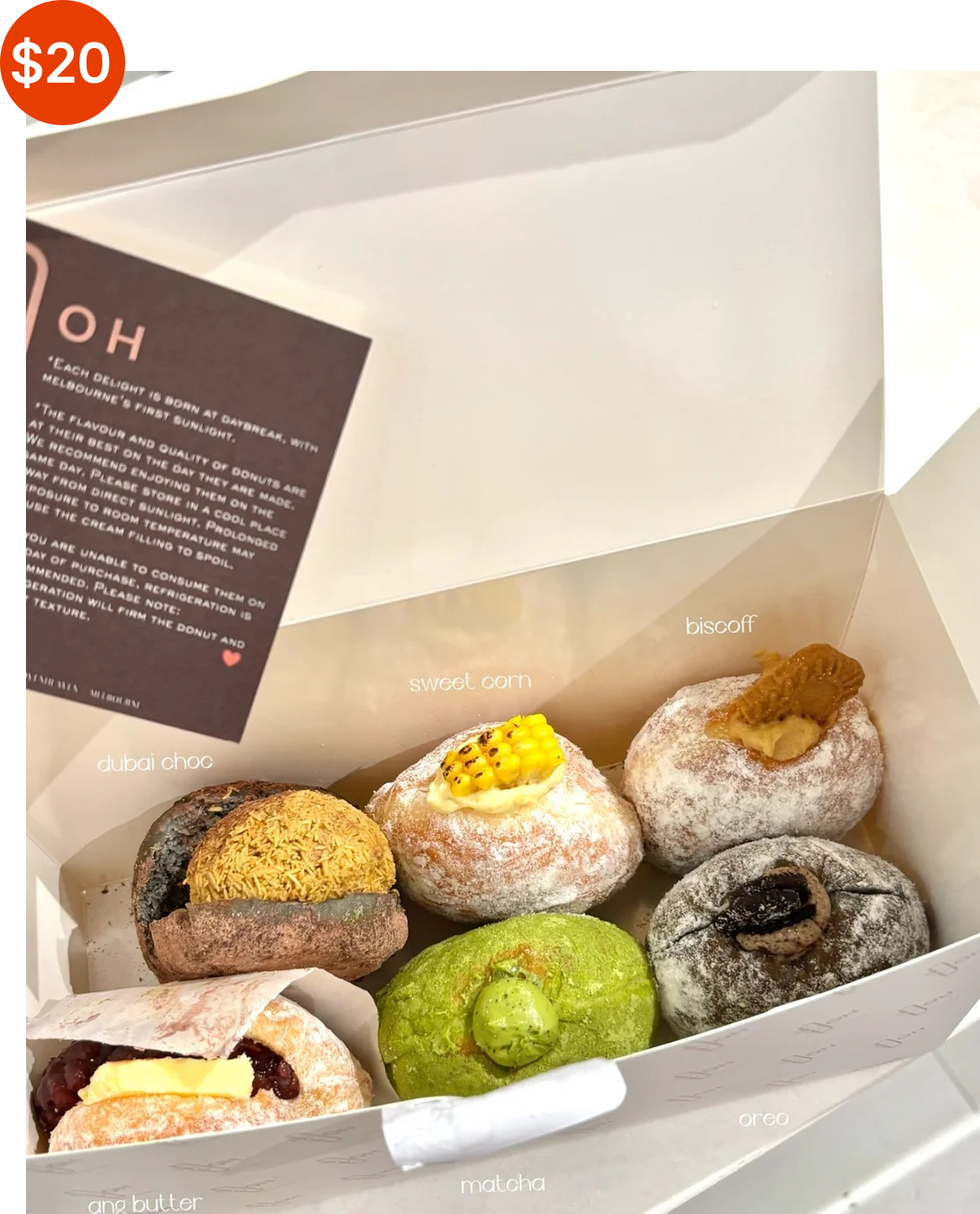
FIG 8. Food as Identity & Lifestyle (After)

02 FIELD RESEARCH
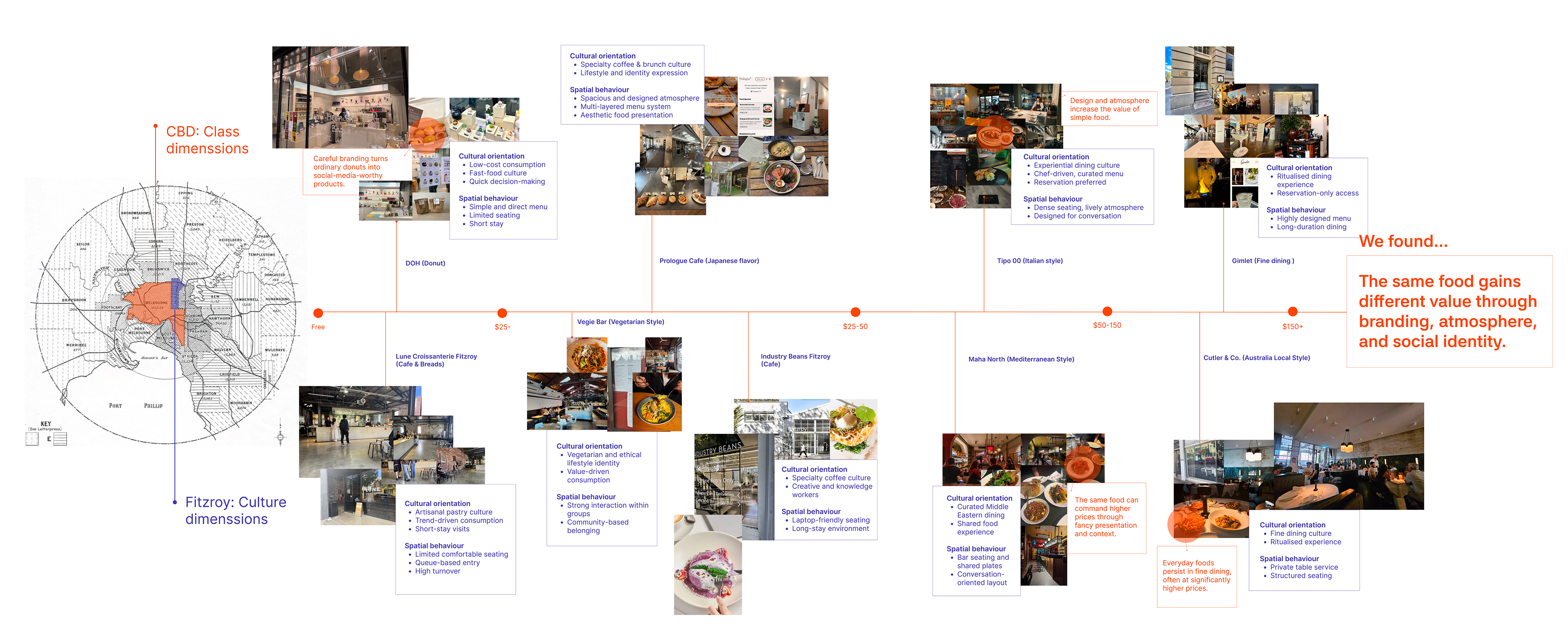
Building on our desk research, we conducted site observations across Melbourne CBD and Fitzroy to understand how food gentrification is experienced in everyday dining spaces. We visited ten restaurants and cafés, spending over two hours observing each location. Beyond documenting physical spaces, we focused on how people discovered, selected, and experienced food venues (FIG.9).
Our observations revealed that dining decisions were often influenced by visual appeal, online reviews, and social media recommendations, while the cultural history and community changes behind these places were rarely noticed. We are targeting urban workers as our primary audience because they frequently move between different food spaces and are more likely to notice these differences in their daily lives. These findings became the foundation for our design direction.

FIG 9. Field Research in Melbourne

Key Insight
Food value is shaped by more than the food itself.
Branding, atmosphere, and cultural expectation influence perceived value. Dining spaces communicate identity, lifestyle, and belonging.

Food gentrification transforms how people experience and participate in urban food culture.

03 DESIGN QUESTION
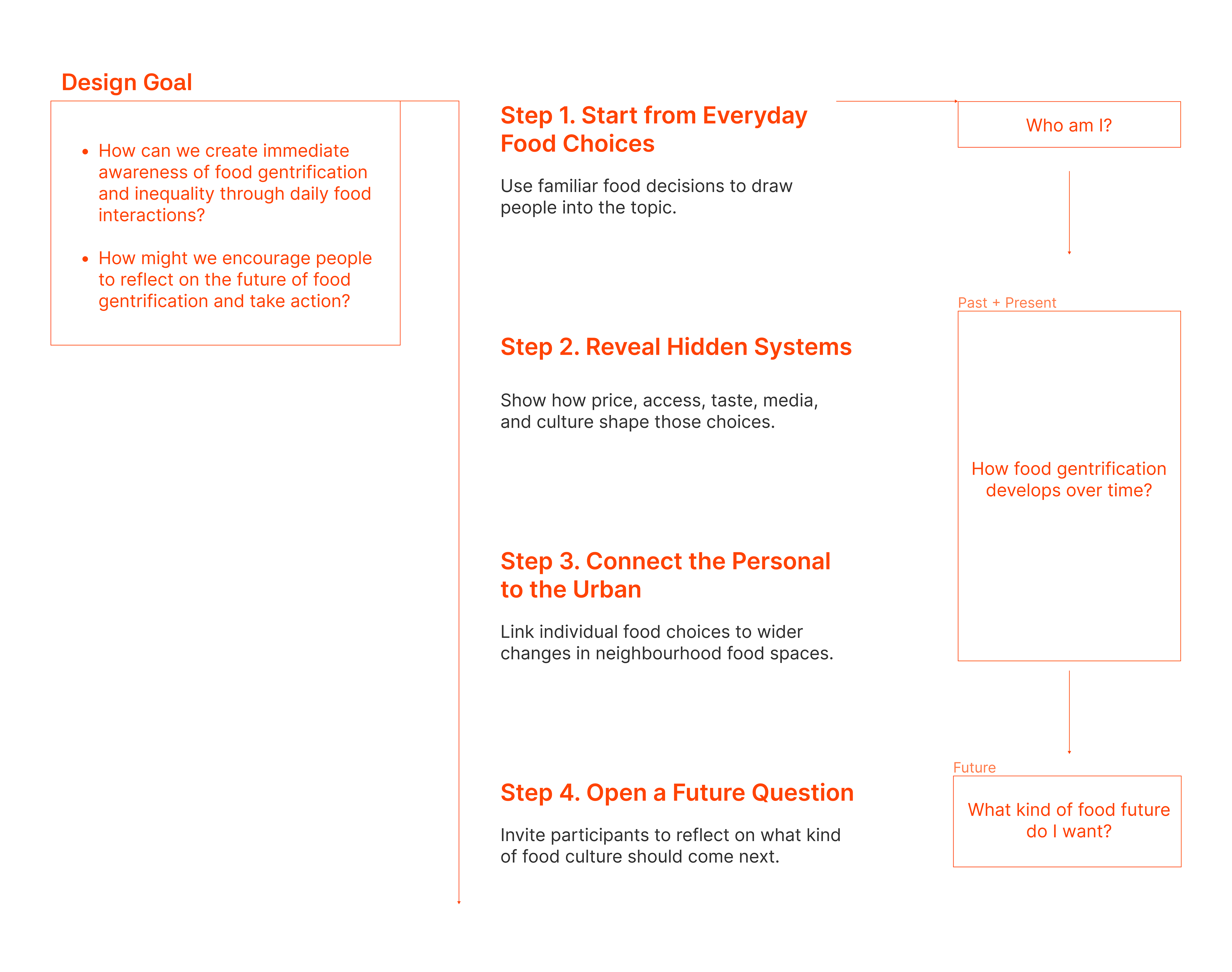
How might we create an interactive experience that helps urban workers recognise, navigate, and reimagine food gentrification in Melbourne?

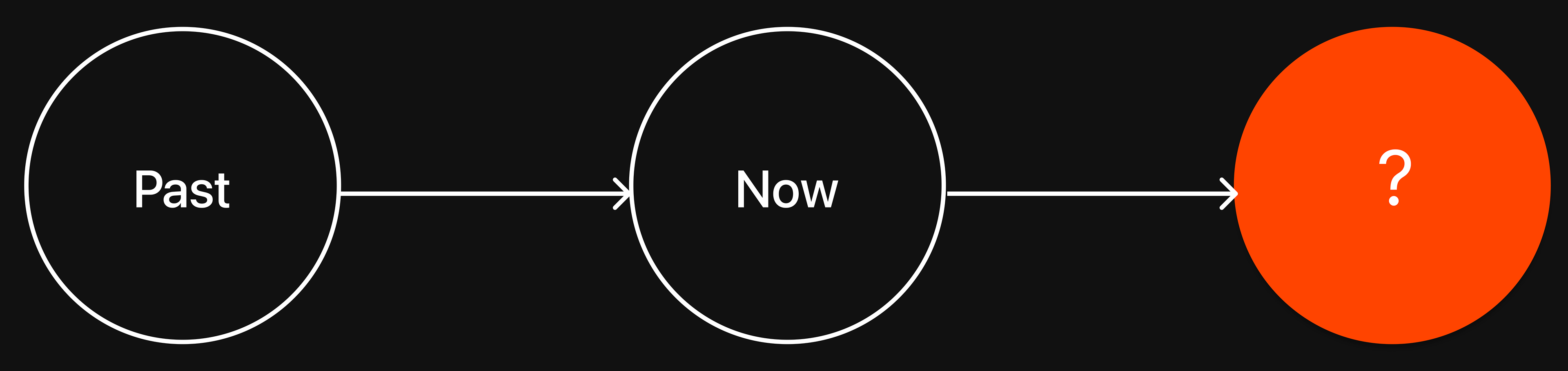
FIG 10. Design Approach

04 DESIGN DECISIONS
04-1 From personal food preferences to collective responsibility
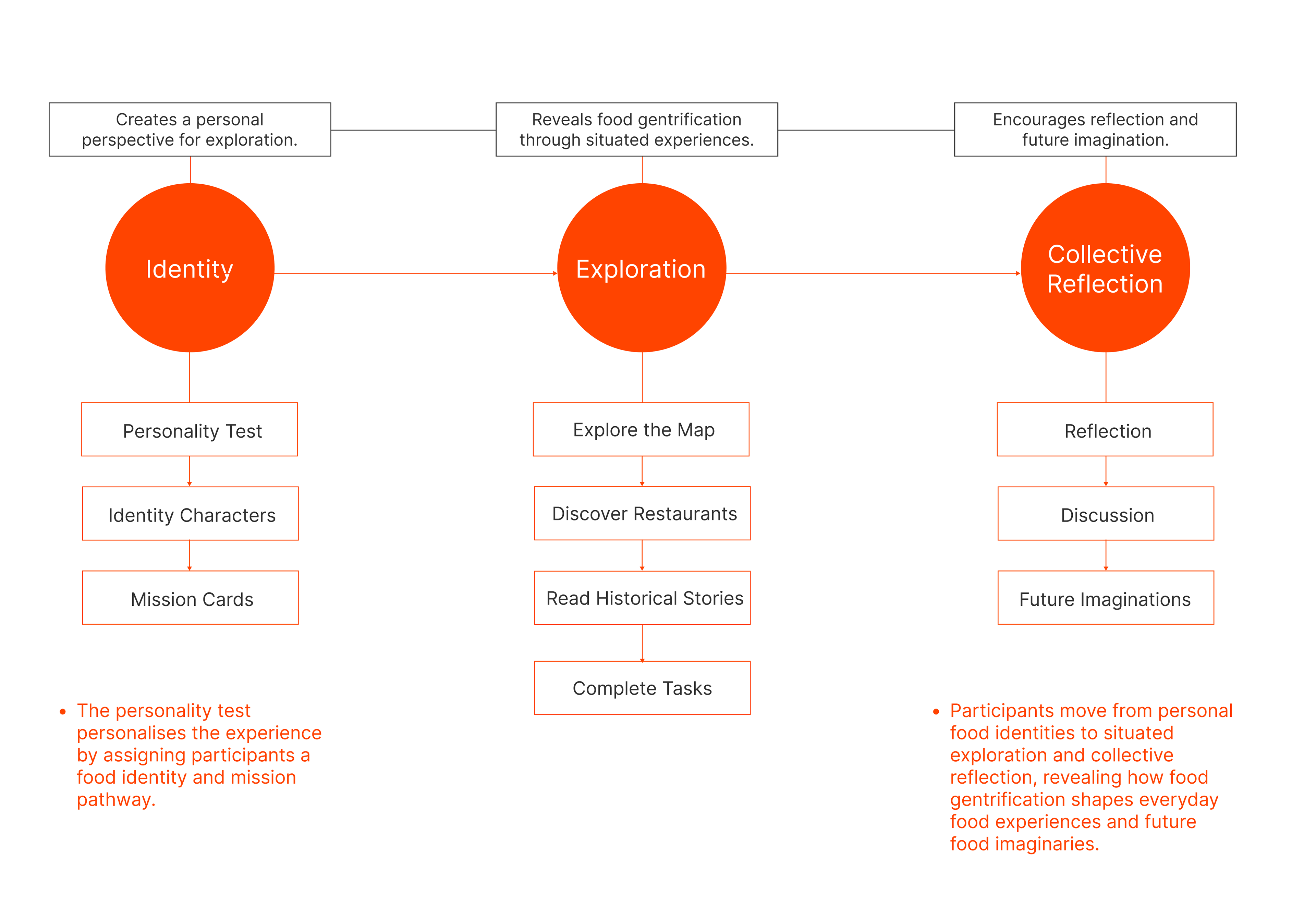
Food gentrification is a complex social issue that quietly reshapes neighbourhoods through everyday dining choices. Most people rarely notice their own role within the process. So we decided to design an experience that begins with visitors' own food preferences and gradually connects individual choices to wider community change (FIG.11).

FIG 11. Design Narrative

04-2 Designing for Exhibition Constraints
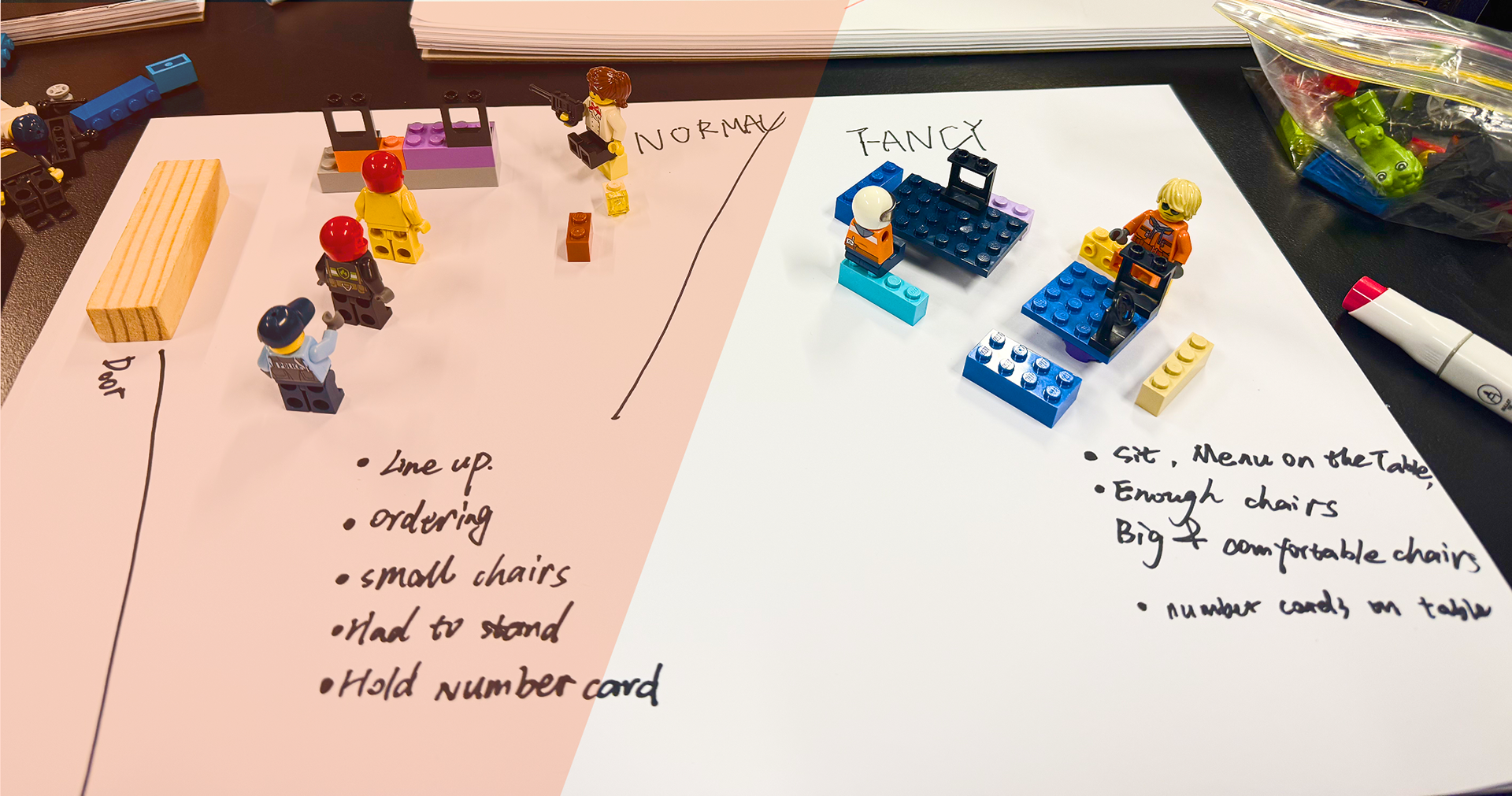
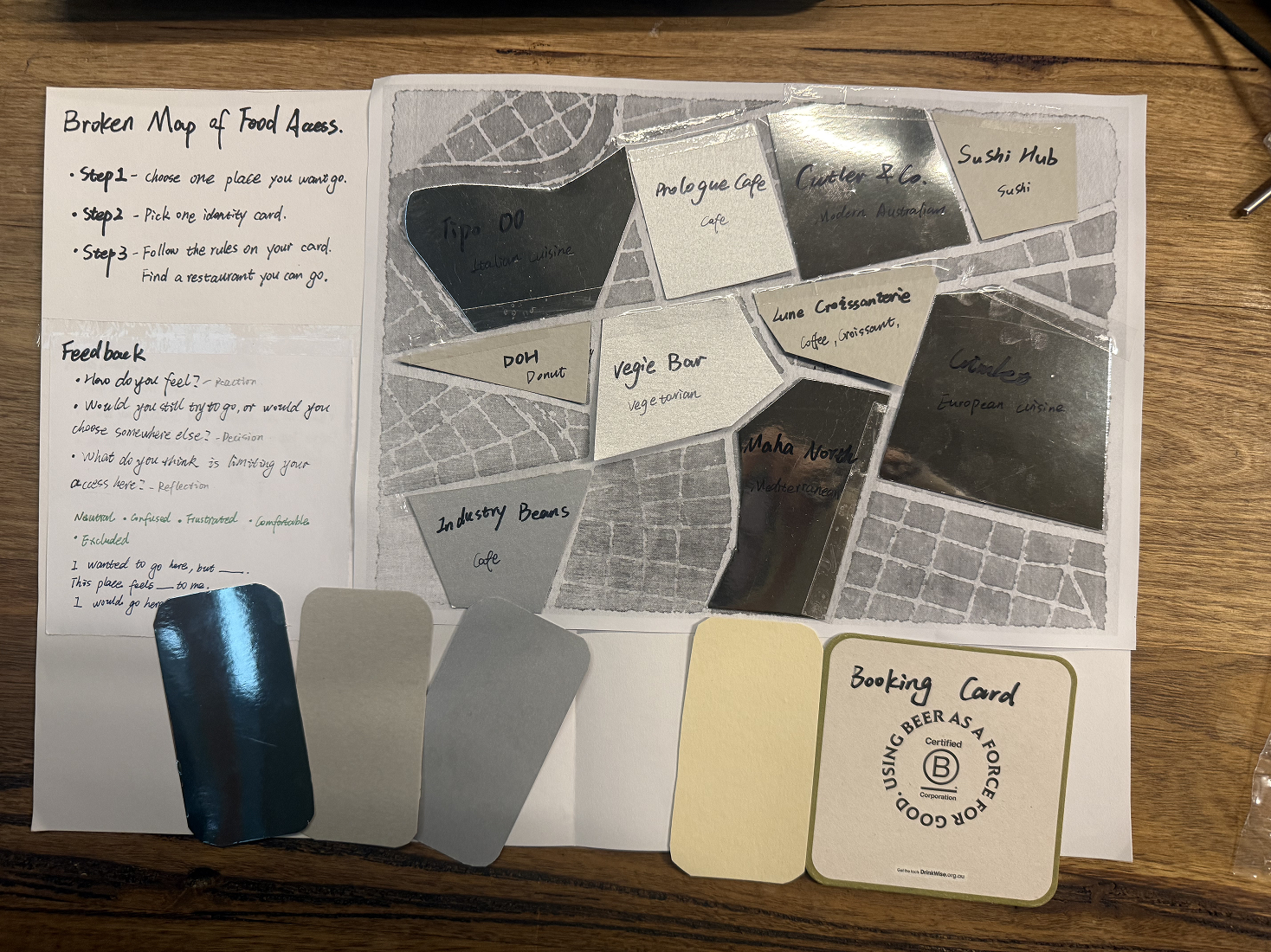
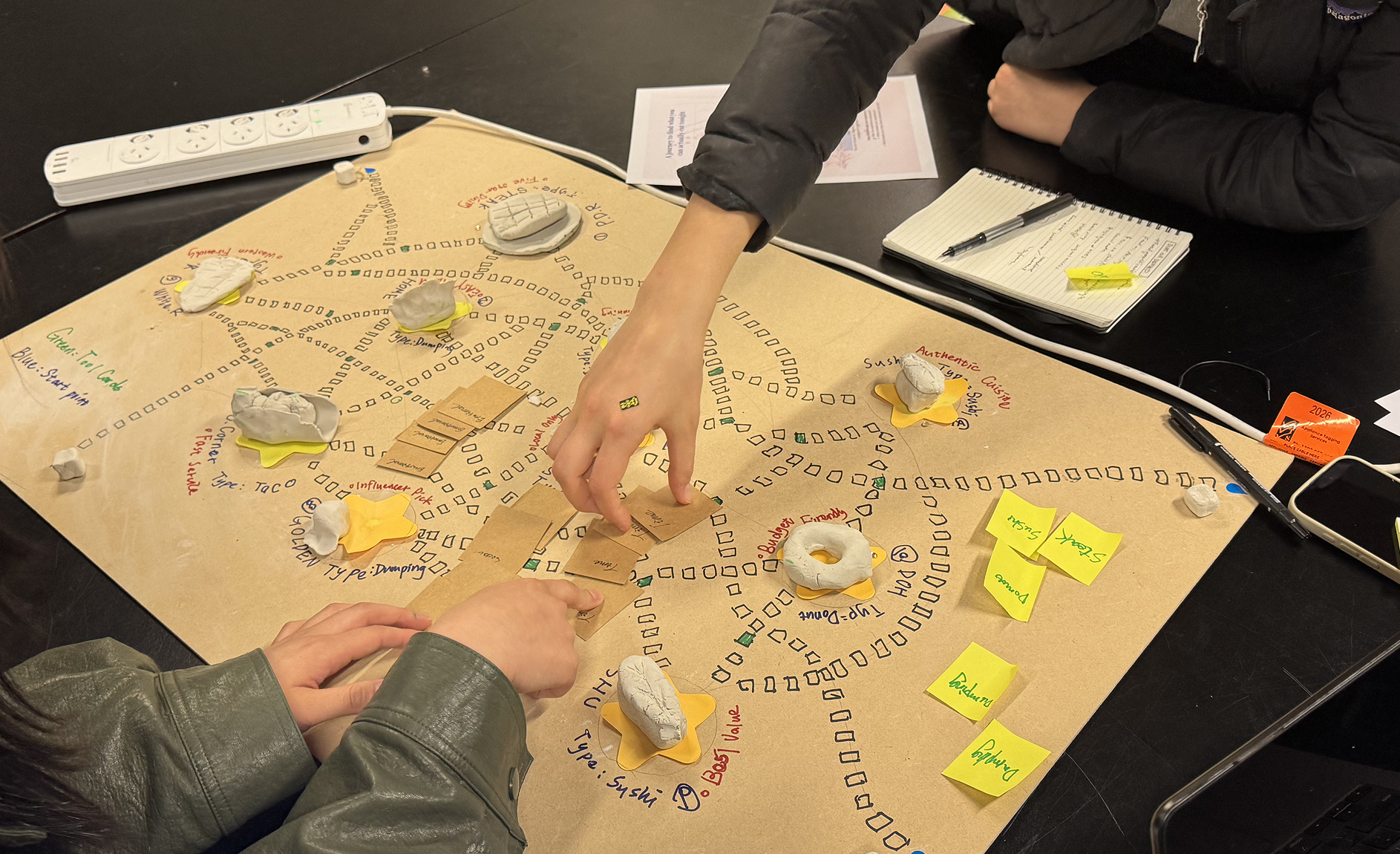
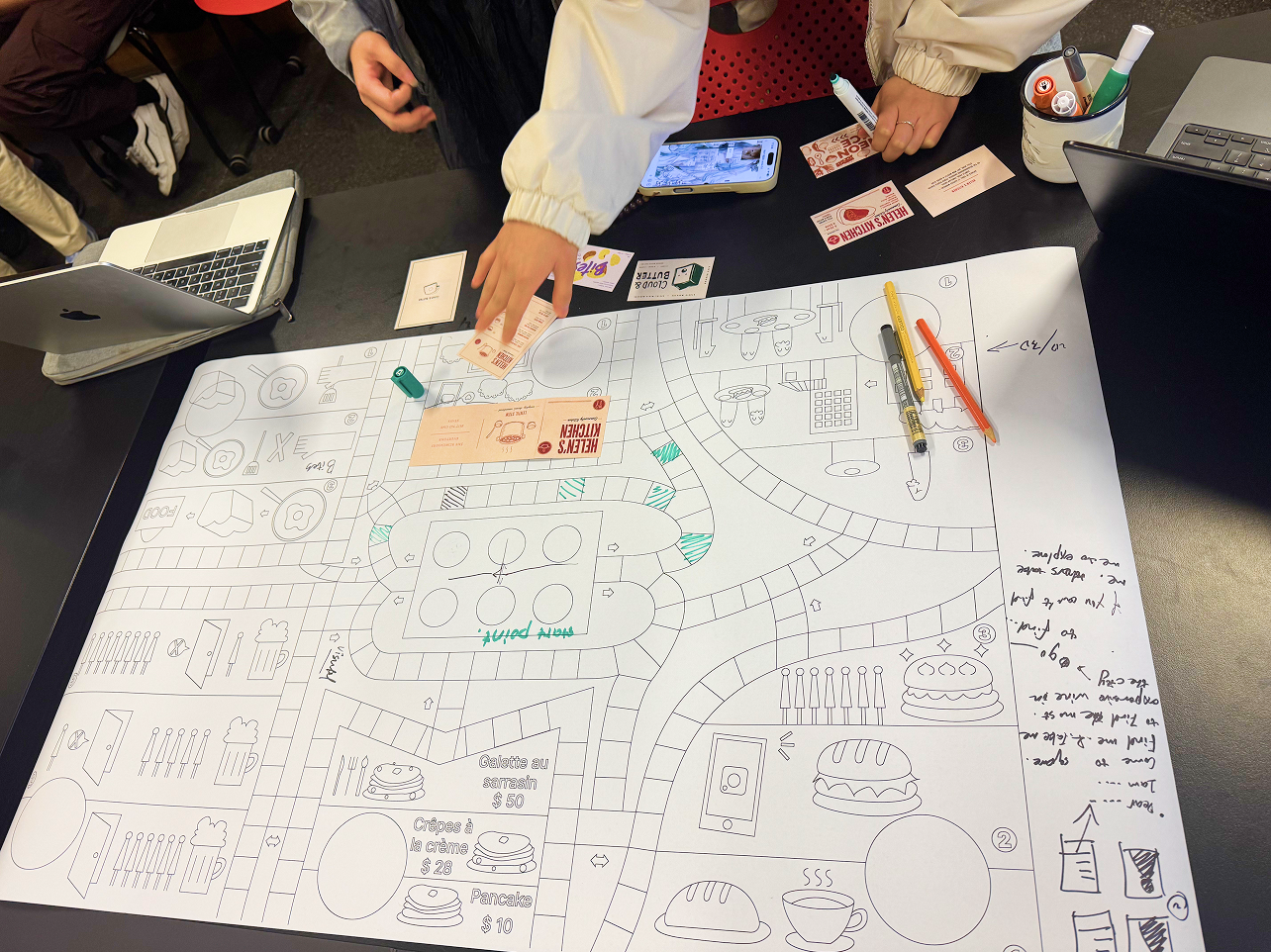
Early prototypes (FIG.12,13) showed that visitors had limited time and attention within an exhibition environment. We decided to create a lightweight, modular experience that could be completed within a short visit while remaining easy to join, pause, and discuss.

FIG 12. Space Experience Test

FIG 13. Melbourne Restaurant Map Prototype
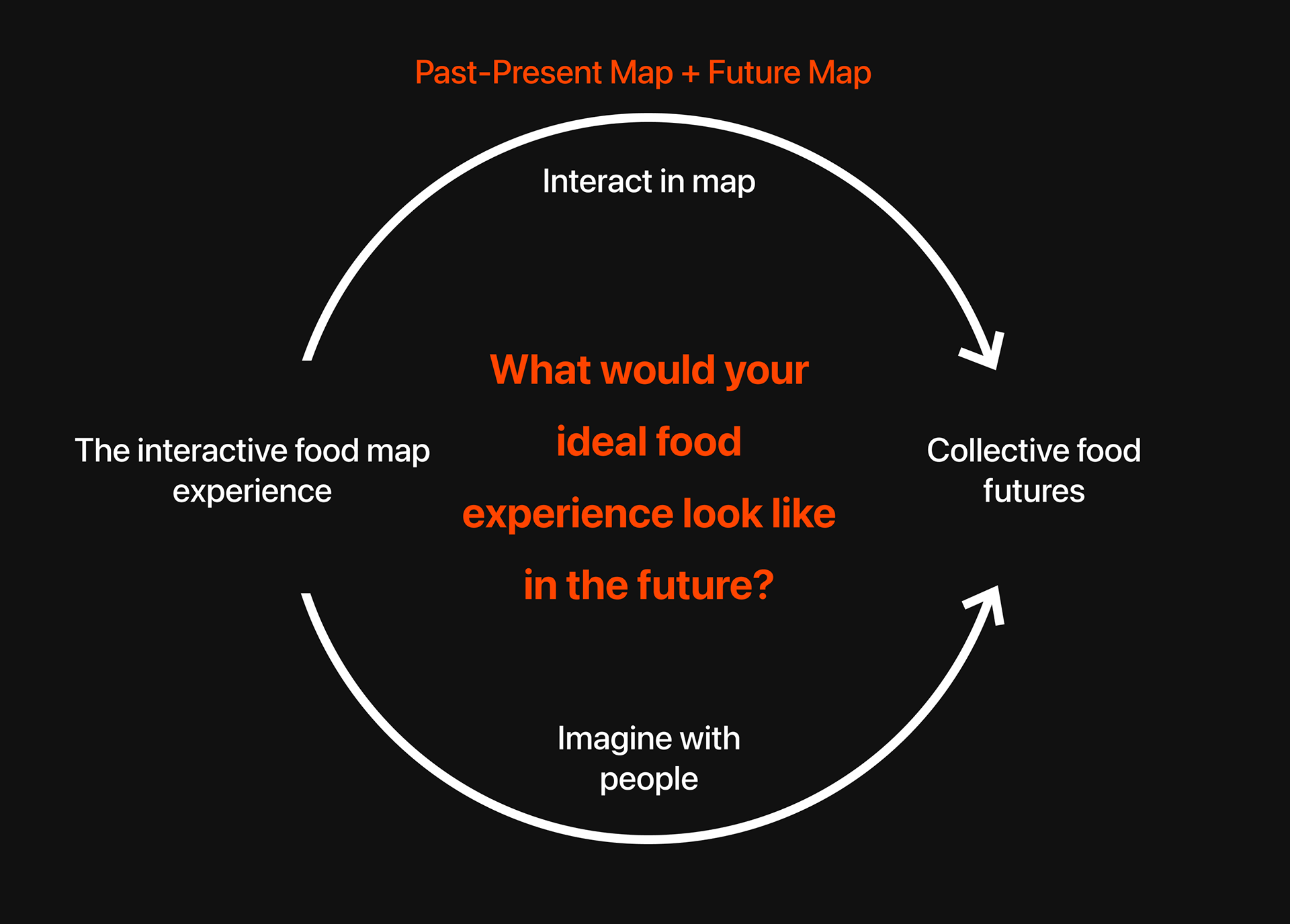
Concept
An interactive map-based experience that invites participants to explore how food gentrification shapes urban food experience, influences everyday food choices over time, and collectively imagine more inclusive food futures.

FIG 14. Experience Concept

04-3 Narrative Before Mechanics
Through two rounds of prototyping (FIG.15,16), we found that visitors had limited time within the exhibition space, while our goal was to encourage understanding and reflection rather than competition. Instead of designing a game with winners and losers, we borrowed narrative elements from puzzle games and embedded the concept of food gentrification into a series of interconnected stories (FIG.17).
Visitors gradually uncover the issue by completing missions, exploring the map, and interacting with materials collected from each restaurant, allowing the experience to unfold naturally through exploration.

FIG 15. First Prototype

FIG 16. Second Prototype
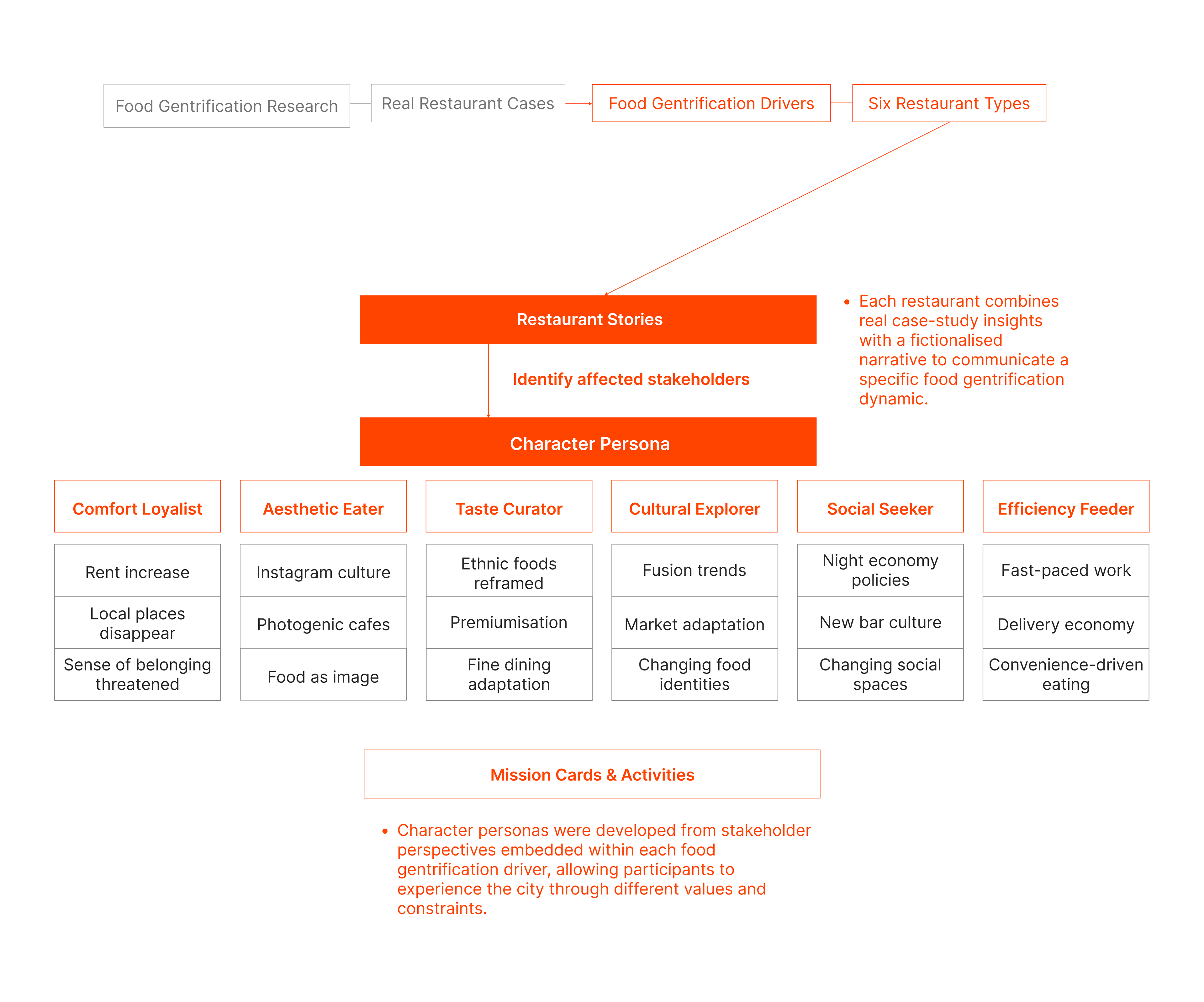
FIG 17. Design System

04-4 Role-playing Builds Empathy
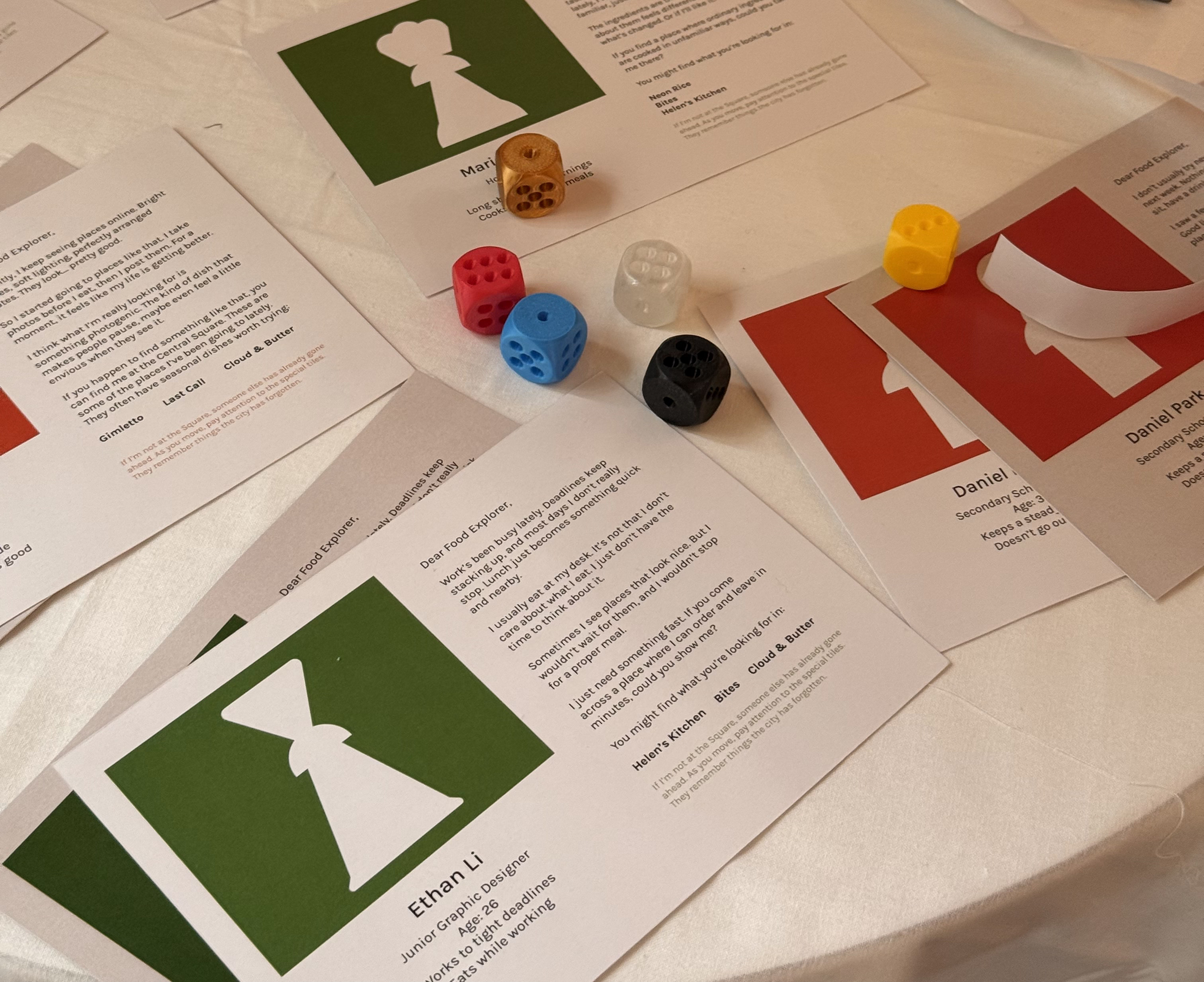
People are naturally more interested in experiences that relate to themselves. Inspired by the familiarity of MBTI-style personality quizzes, based on the real restaurants, communities, and observations gathered during our site research, we developed the personality quiz and corresponding role cards. Visitors are first matched with a role through their own food preferences before stepping into storylines inspired by real food spaces (FIG.18).
Starting from familiar personal experiences allows participants to gradually shift from "my dining choices" to the perspectives of different stakeholders, encouraging empathy while helping them recognise that their everyday choices are also part of the system shaping local communities.

FIG 18. Experience Journey

FIG 19. Final Sketch

05 USER FLOW

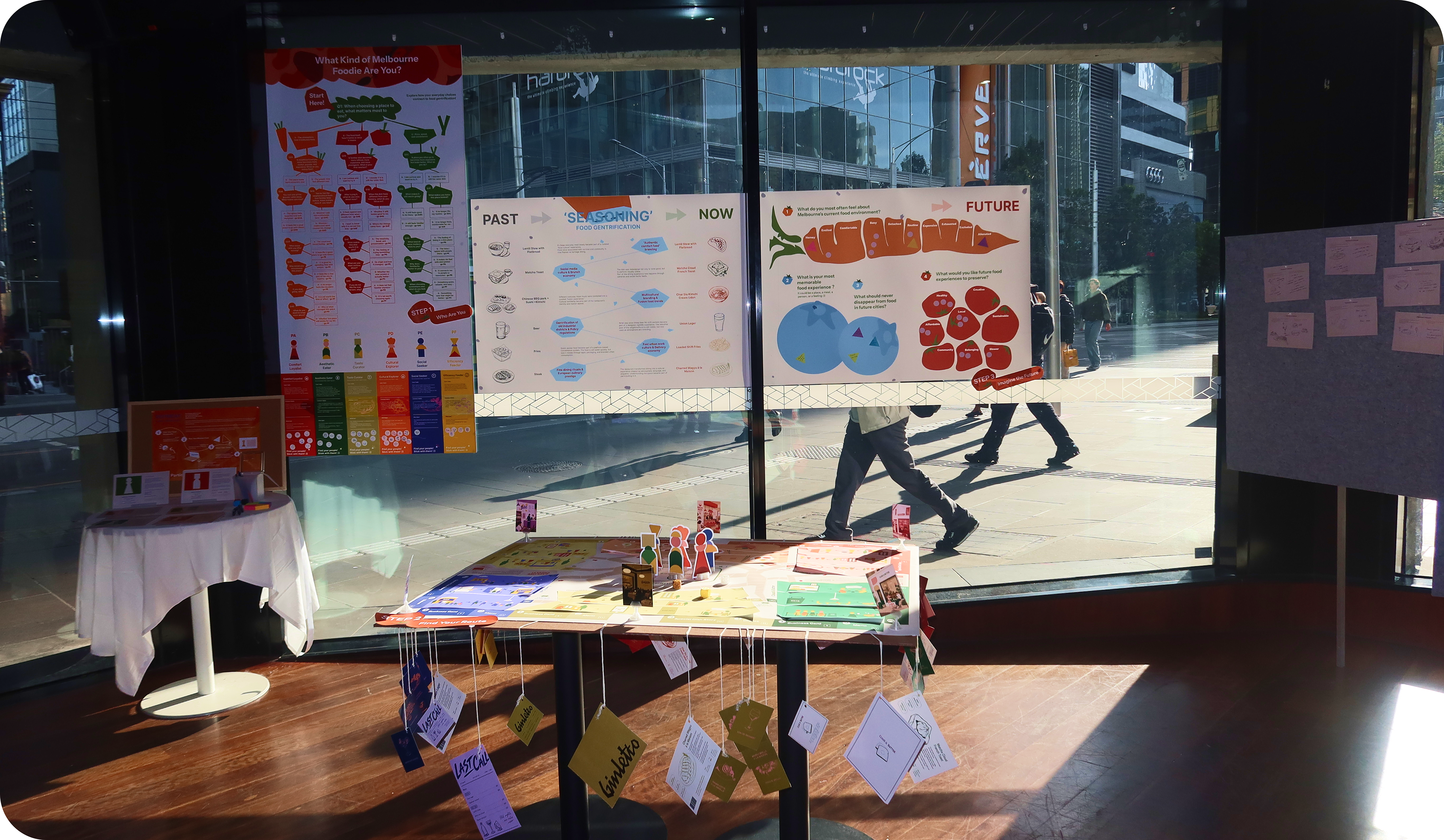
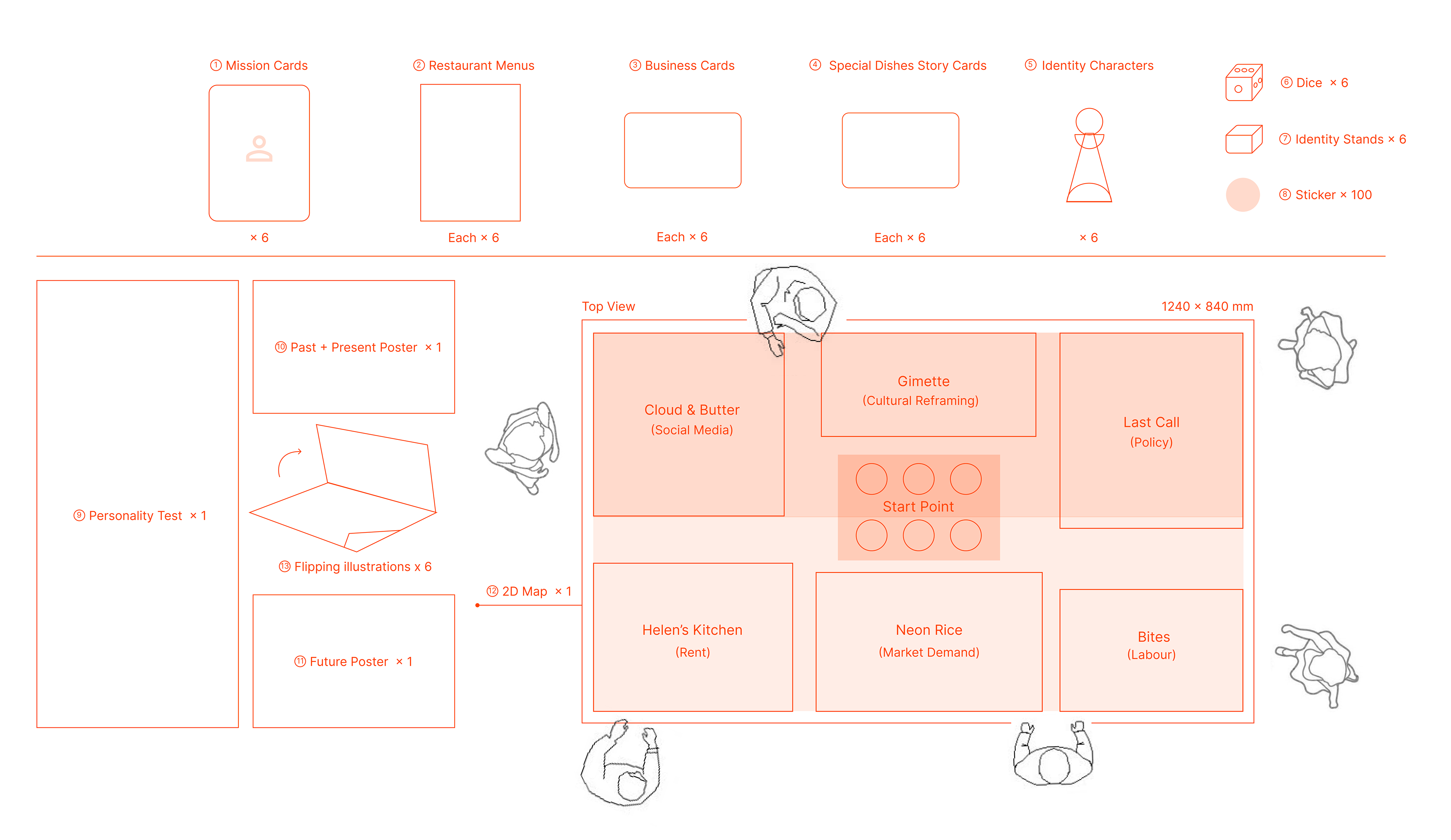
FIG 20. Exhibition Set Up

06 VISUAL DESIGN
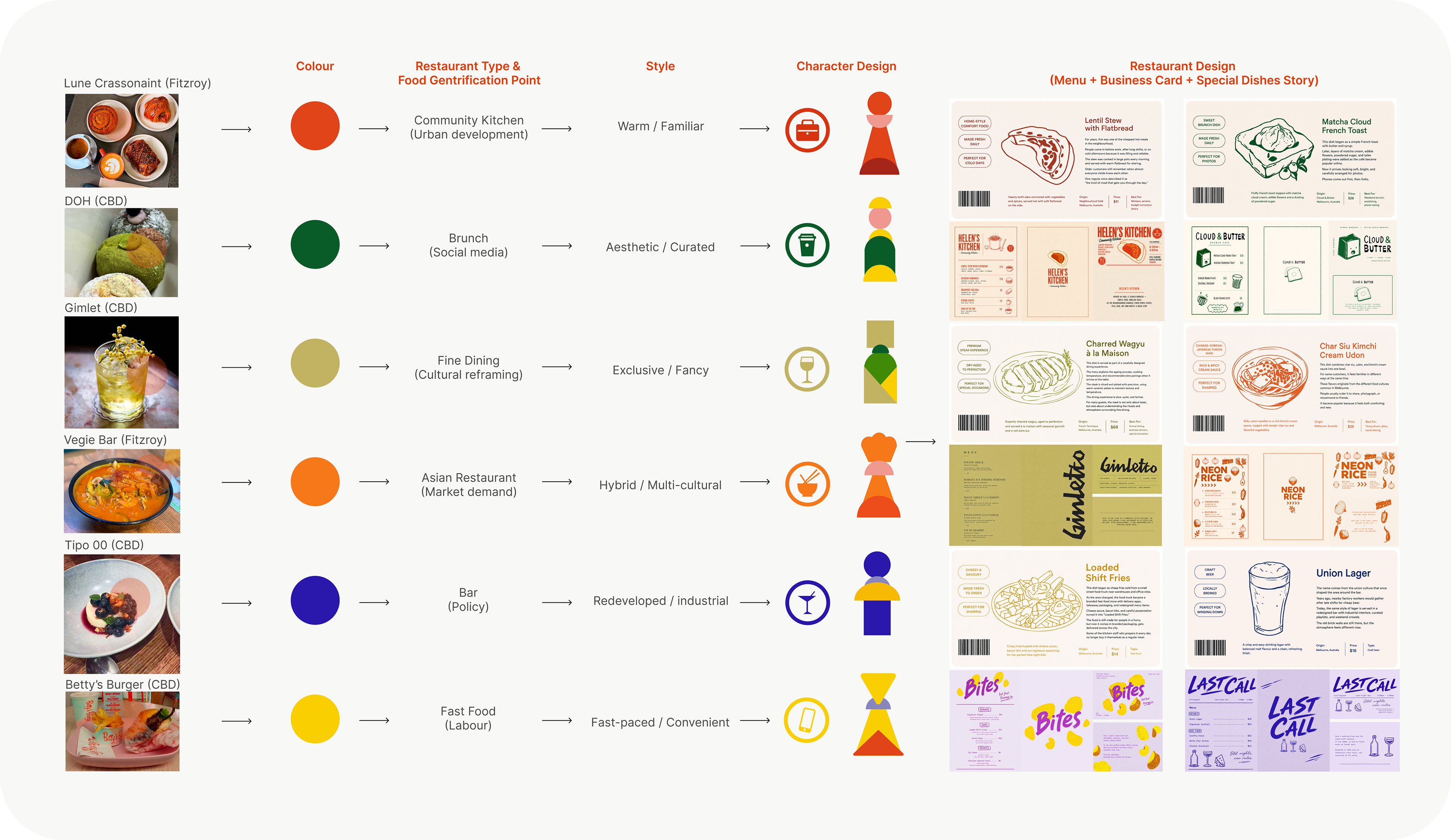
The visual identity was developed from the signature dishes of the ten restaurants documented during our field research, allowing each restaurant to reflect a distinct driver of food gentrification (FIG.21).
We also created six character personas based on these restaurant identities. Early testing showed that figurative characters could unintentionally influence participants' perceptions, so we refined them into a more abstract geometric style to encourage focus on the stories rather than personal attributes (FIG.22).

FIG 21. Visual Design Principles

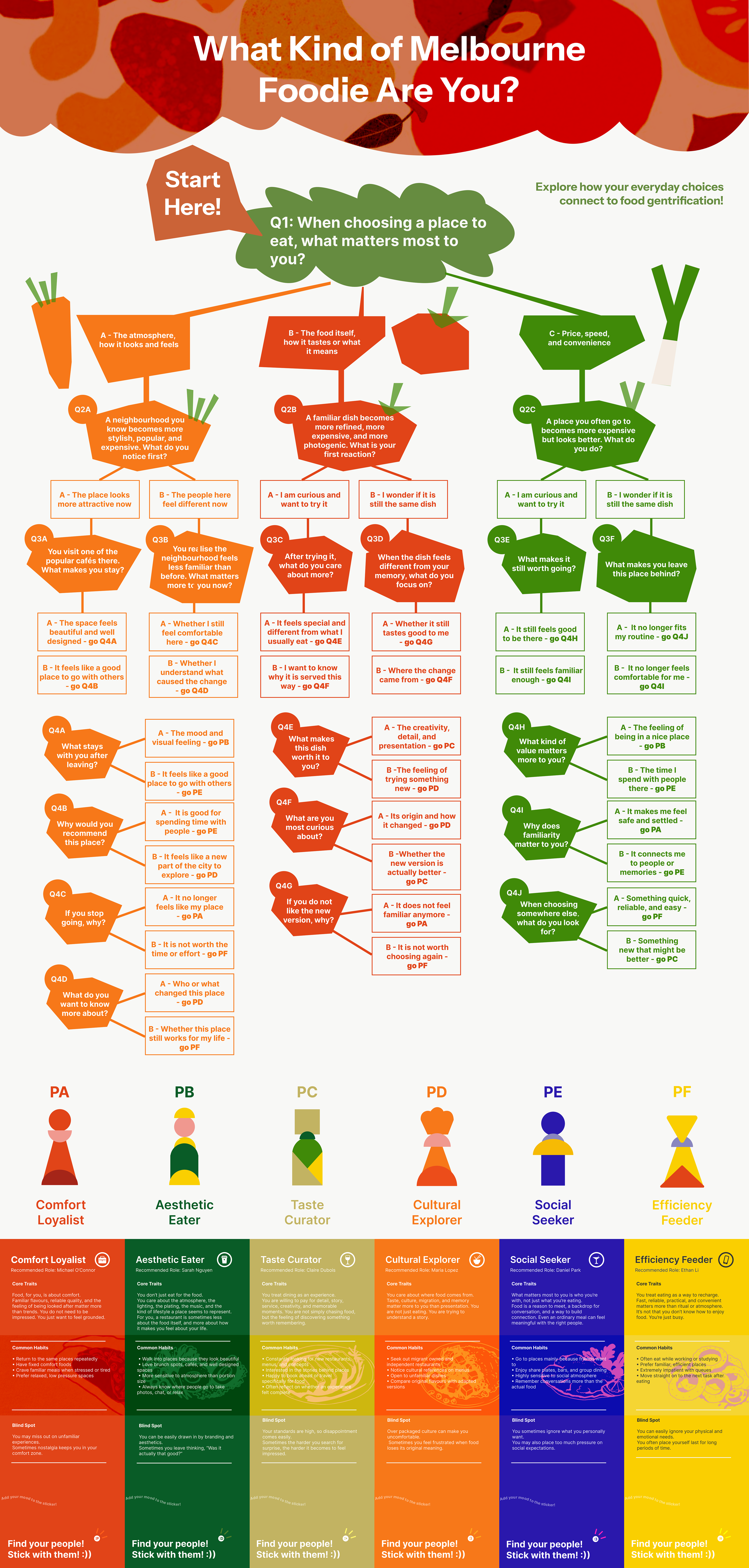
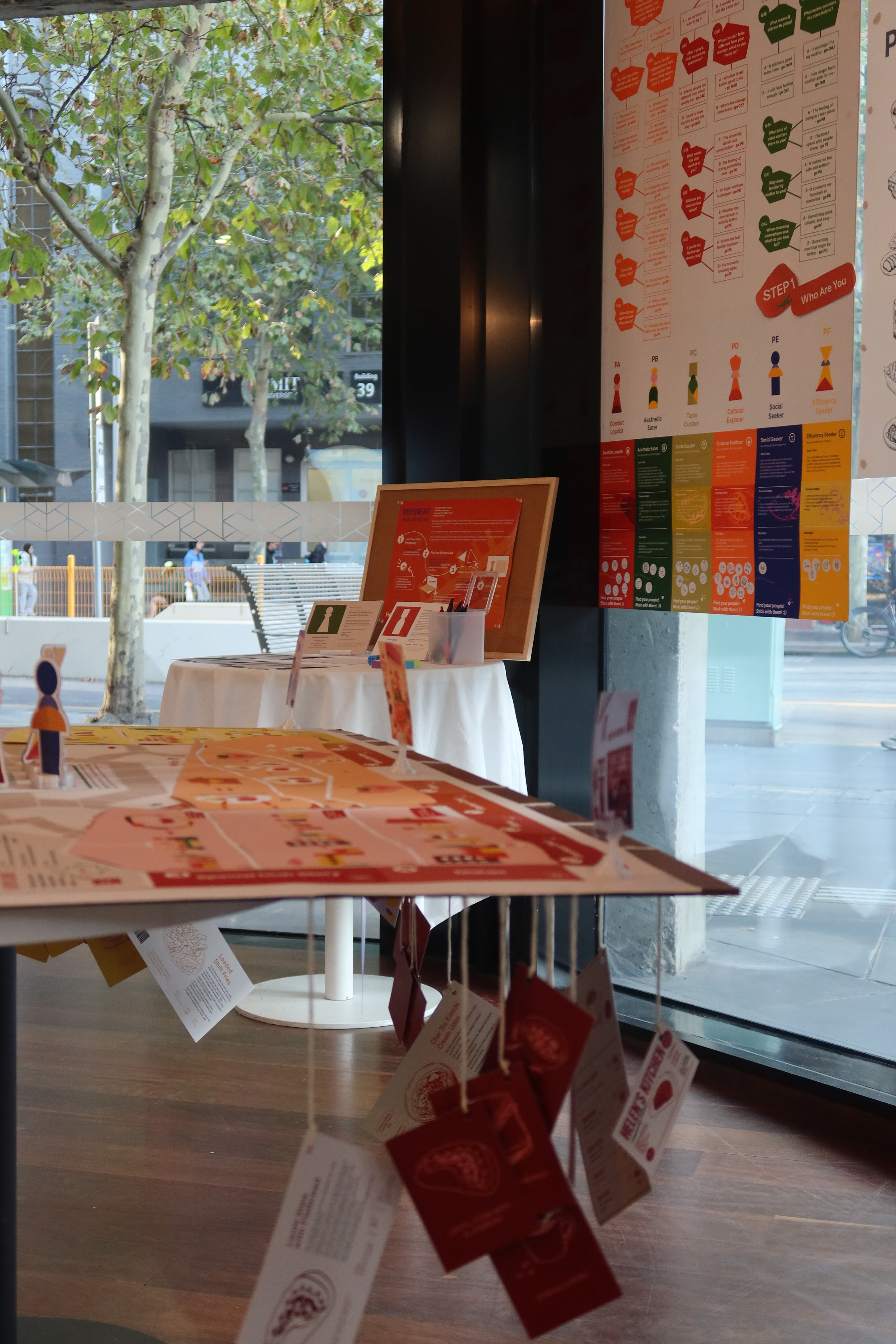
Personality Quiz
We translated the causes and impacts of food gentrification into questions based on everyday dining preferences. The quiz gradually guides visitors from personal choices to social reflection.
After receiving one of six personas, participants can read their profile and place a sticker in the matching category, encouraging participation and discussion throughout the exhibition (FIG.22).
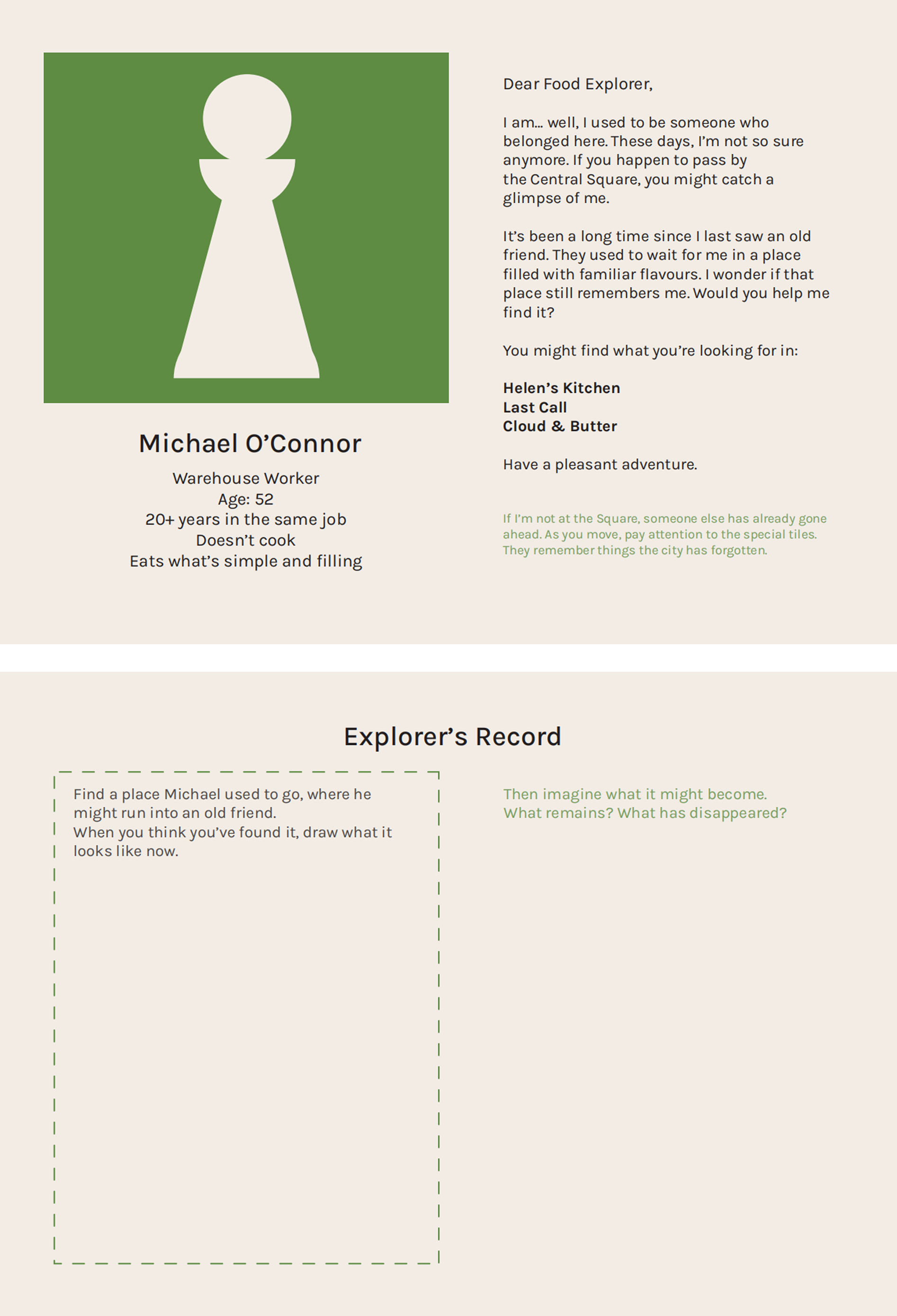
Mission Cards
After receiving their persona, visitors collect the matching mission card and follow the character's story to explore the map (FIG.23). The narrative gradually guides them through real restaurants and encourages reflection throughout the journey.

FIG 22. Personality Test Design

FIG 23. Mission Card Design (Front and Back Side)
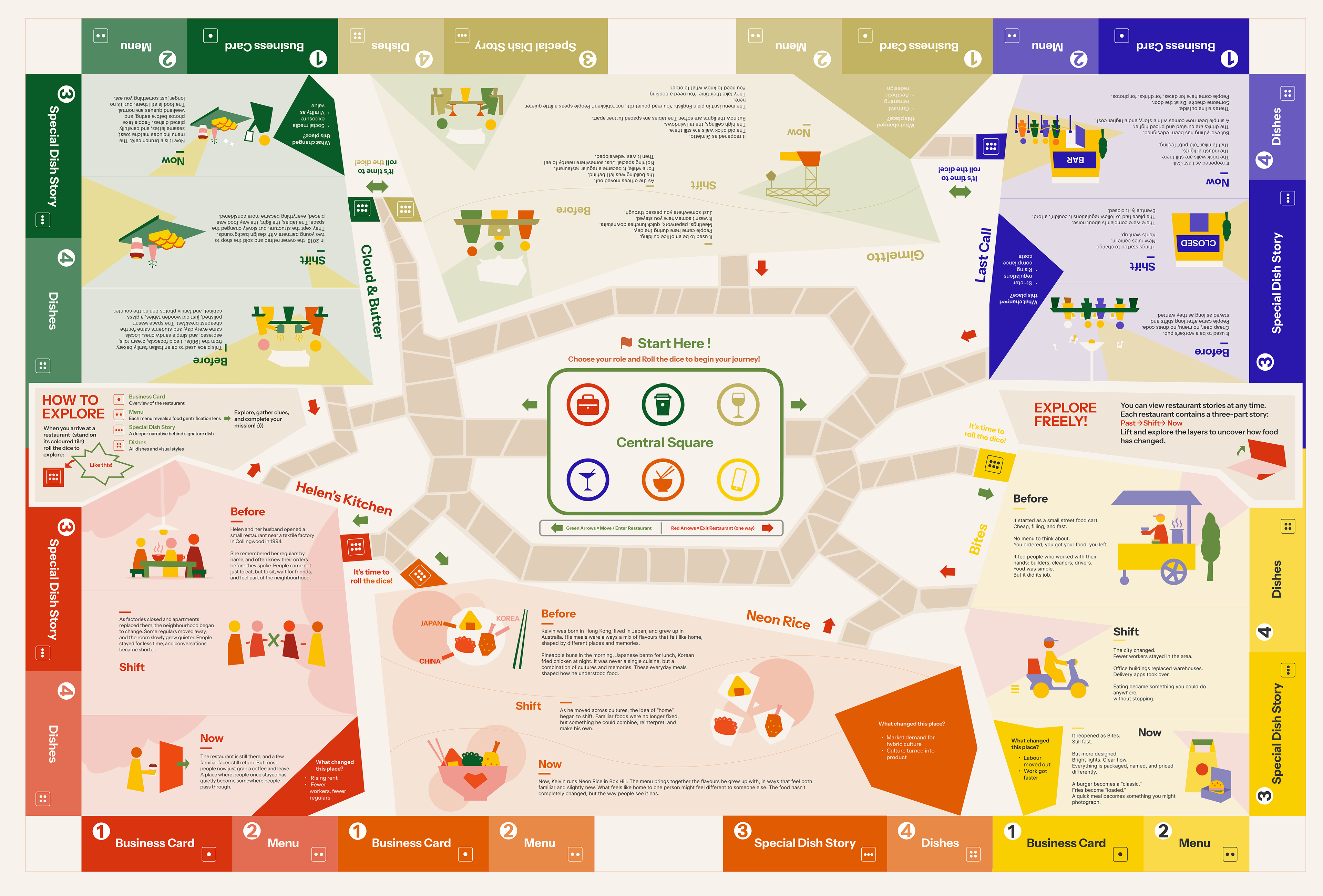
Map Design
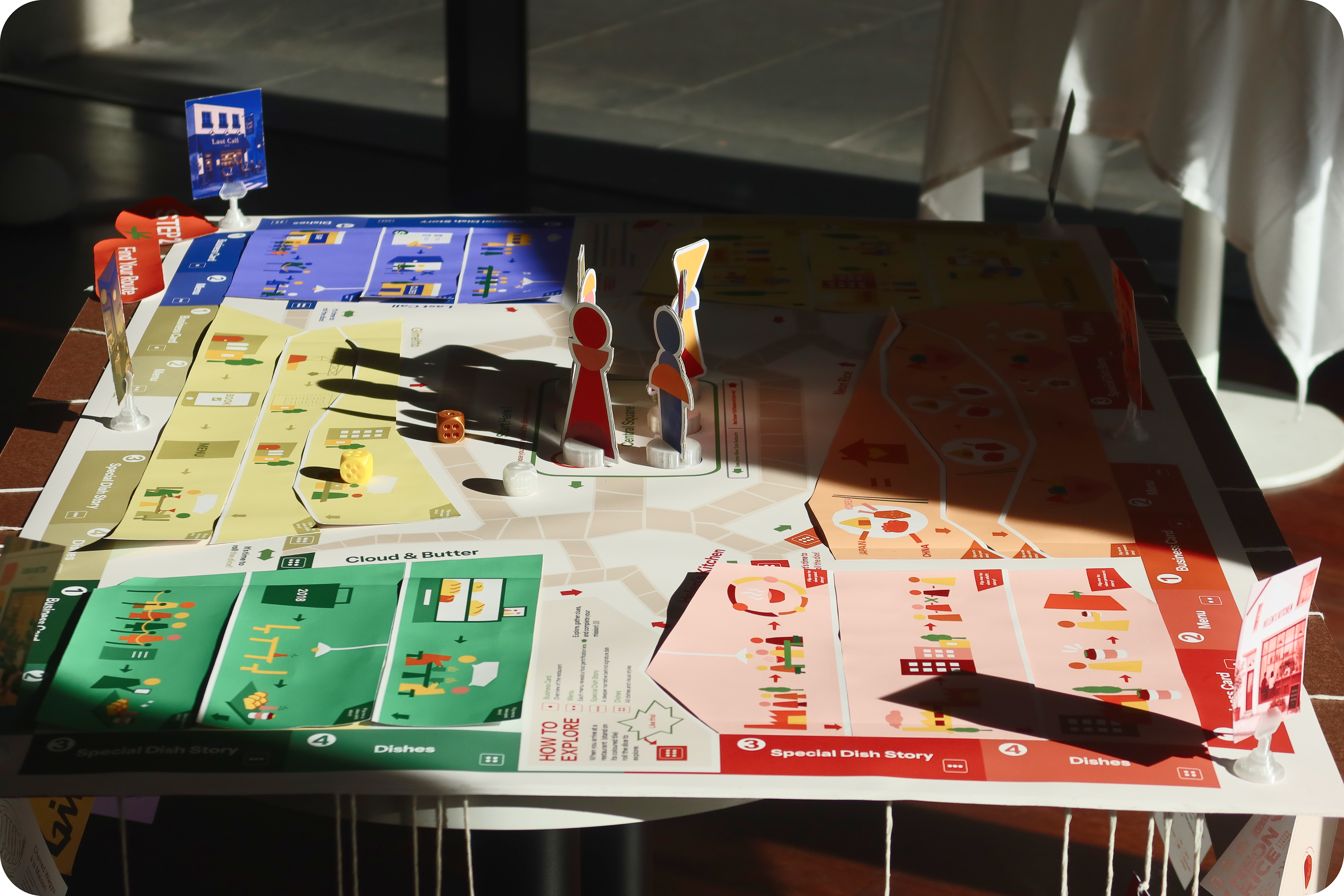
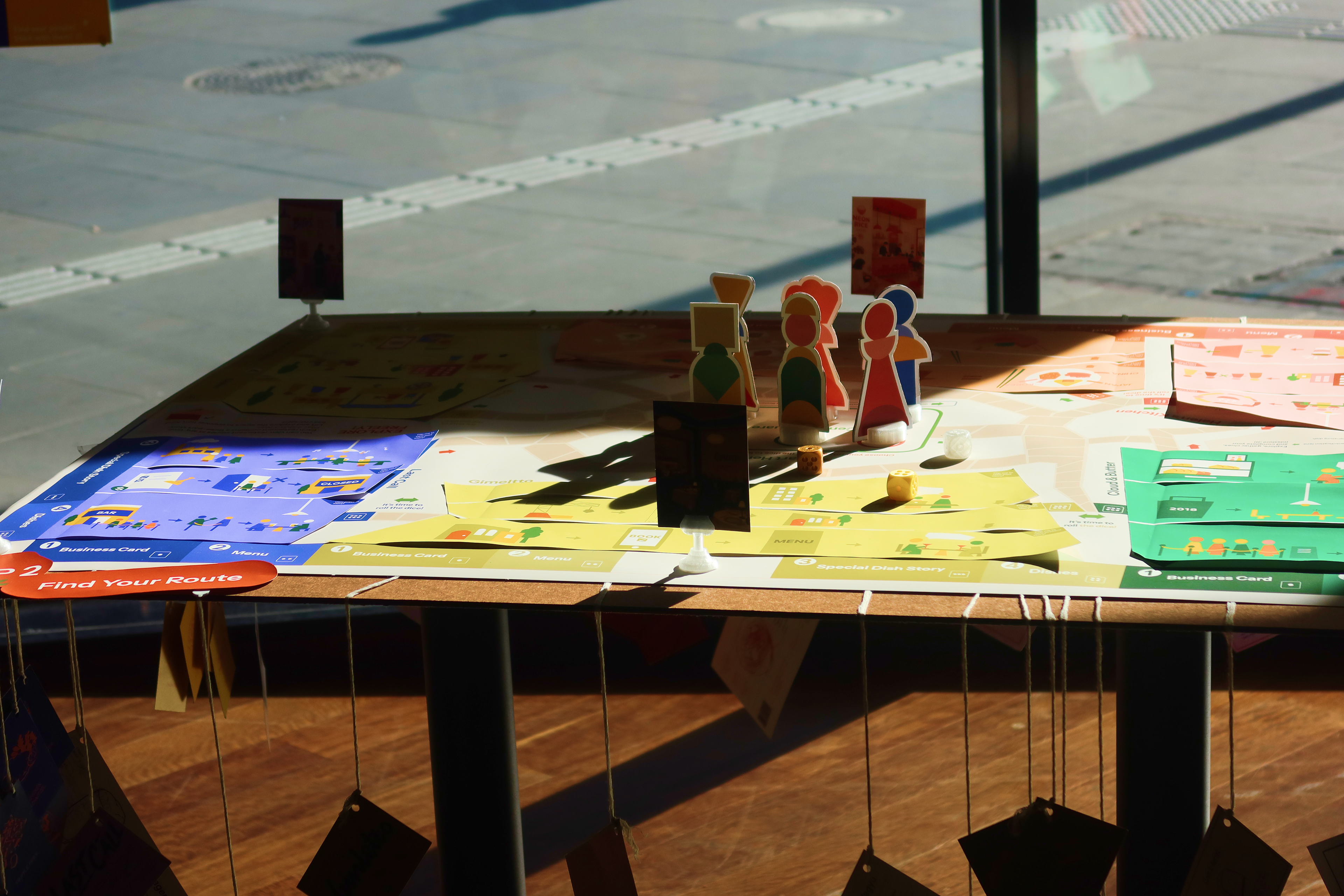
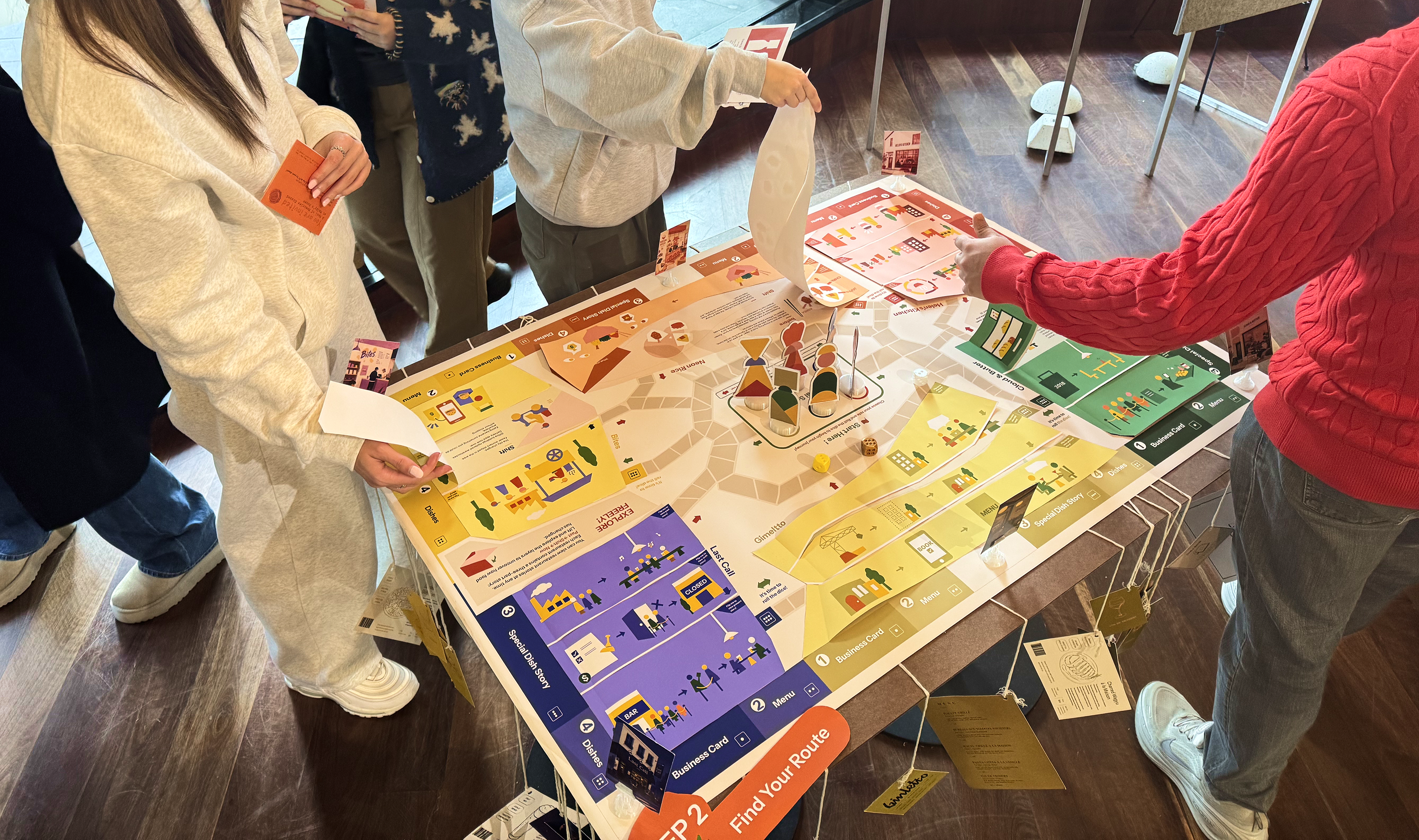
We designed the map to resemble a real neighbourhood. Irregular streets and restaurant districts encourage participants to explore naturally, making the experience feel more like discovering a city than following a predefined route (FIG.24,25).
The same visual language was applied across the map, restaurant stories, and supporting materials, creating a consistent experience throughout the exhibition.

FIG 24. Map without Cover (1240 mm x 840 mm)
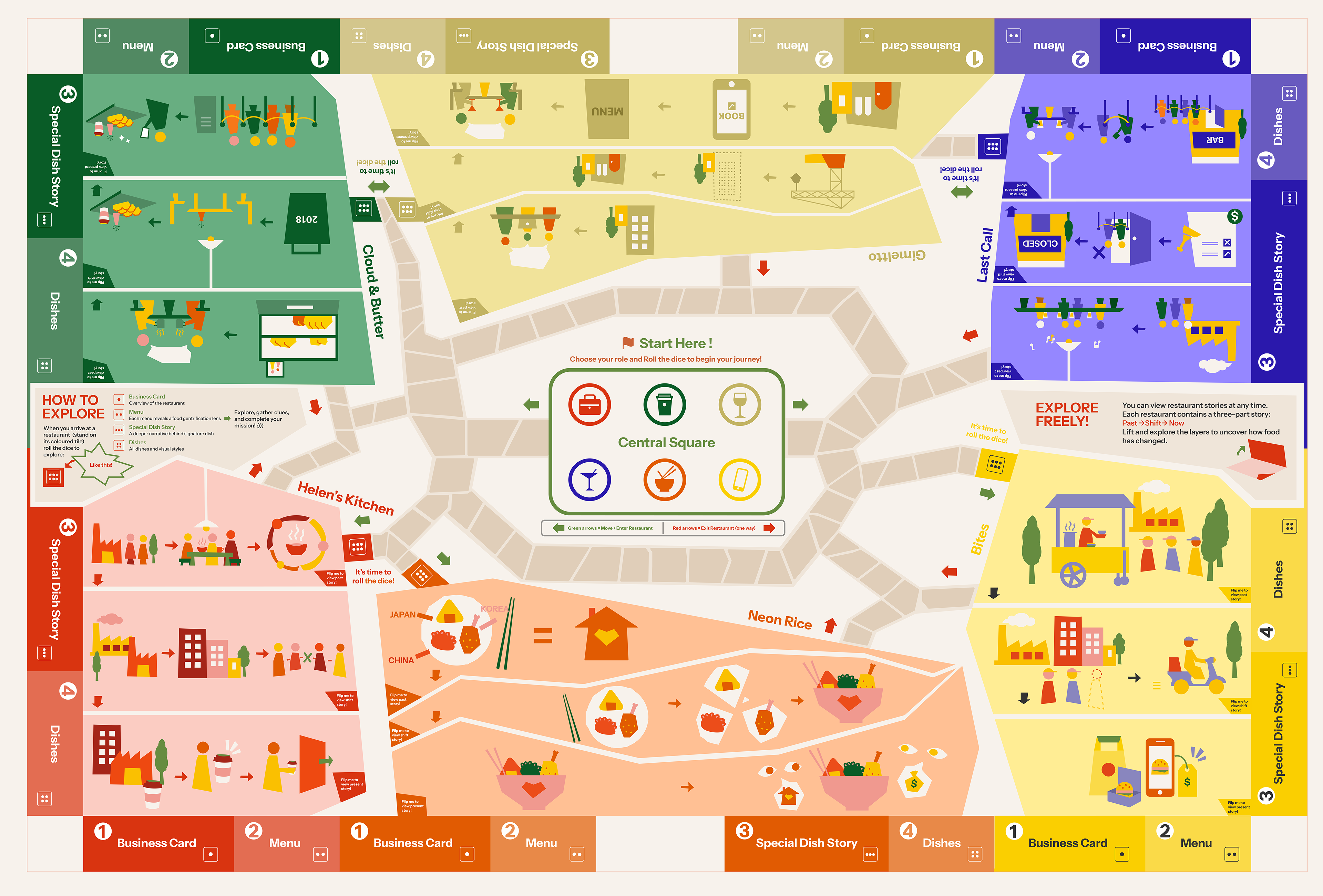
FIG 25. Map with Cover (1240 mm x 840 mm)
Story Illustration 
Brochures
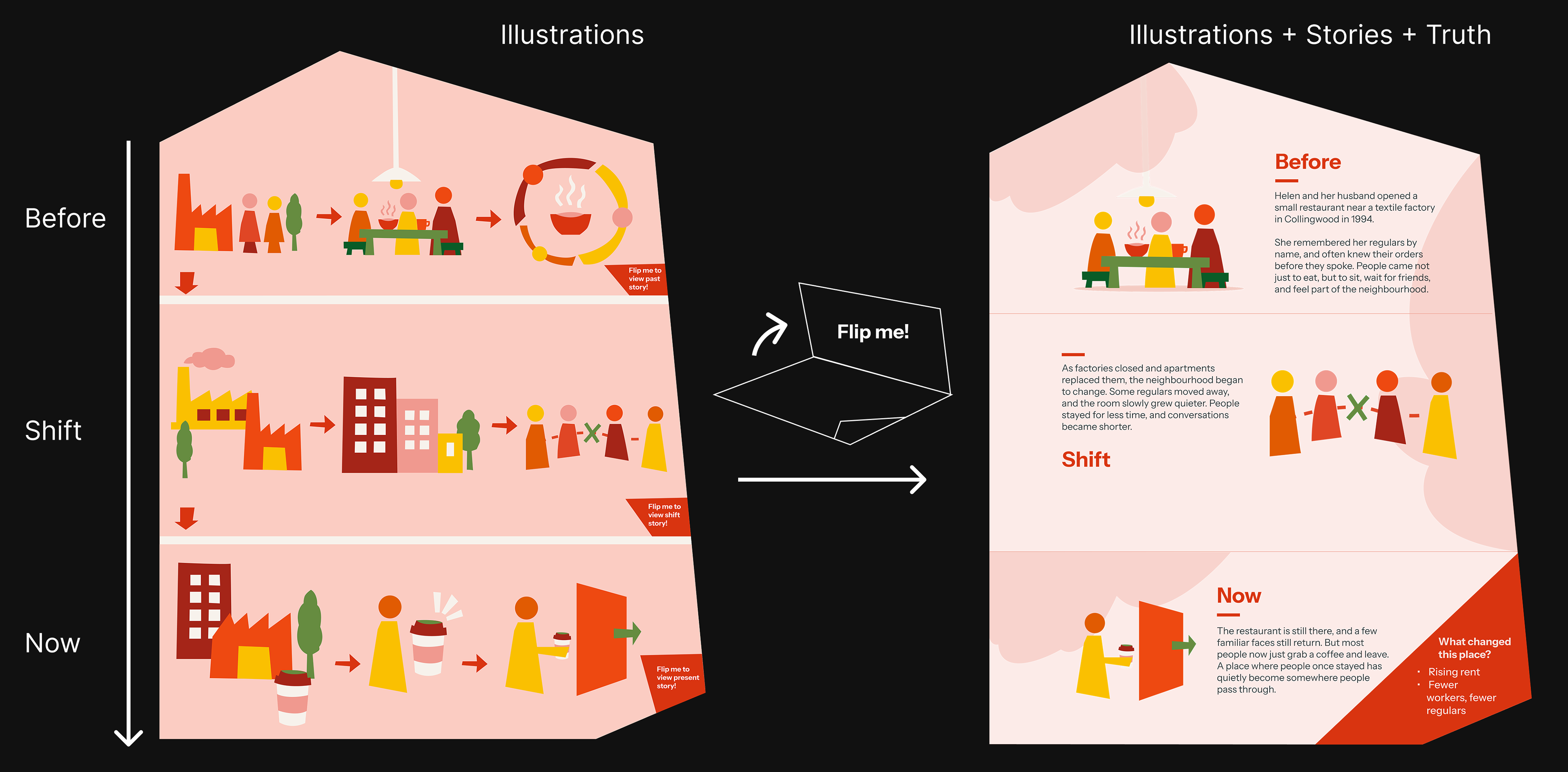
To make a complex urban process easier to understand, each restaurant story is structured into three stages: Before, Shift, and Now.
Before introducing the restaurant's original role within the community. Shift explains the social, cultural, or economic forces behind the transformation. Now presents the restaurant after these changes, encouraging participants to connect individual stories with the broader process of food gentrification.

FIG 26. Story Illustration Design

History Posters
We designed an overview poster to introduce food gentrification to visitors who were waiting or observing, allowing them to understand the topic before joining the experience.
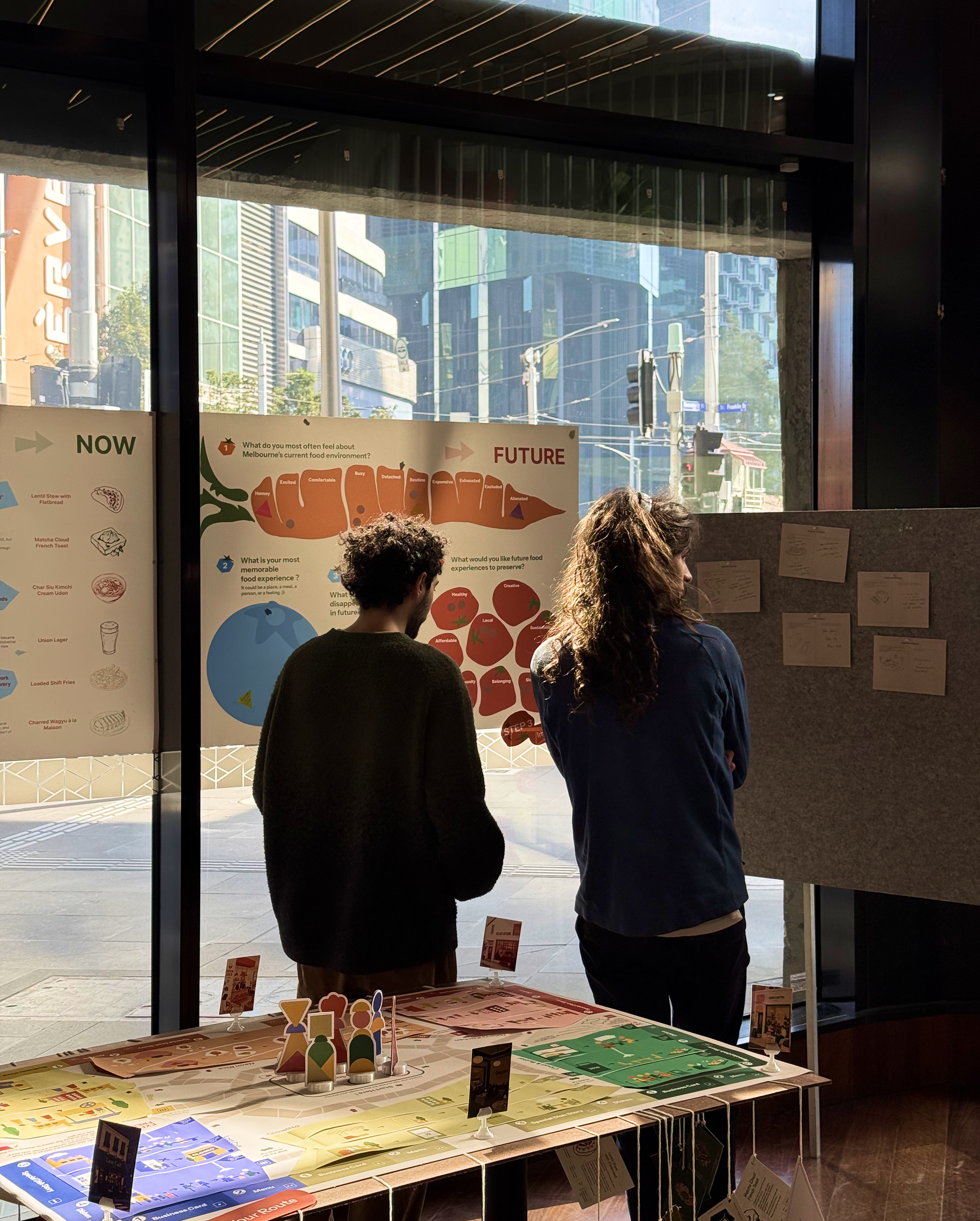
Using seasoning as a metaphor, the poster visualises how different social, cultural, and economic factors gradually reshape food spaces (FIG.27). Using stickers to reflect on their own food experiences and imagine the future of local food communities (FIG.28).

FIG 27. Food Gentrification Process Poster
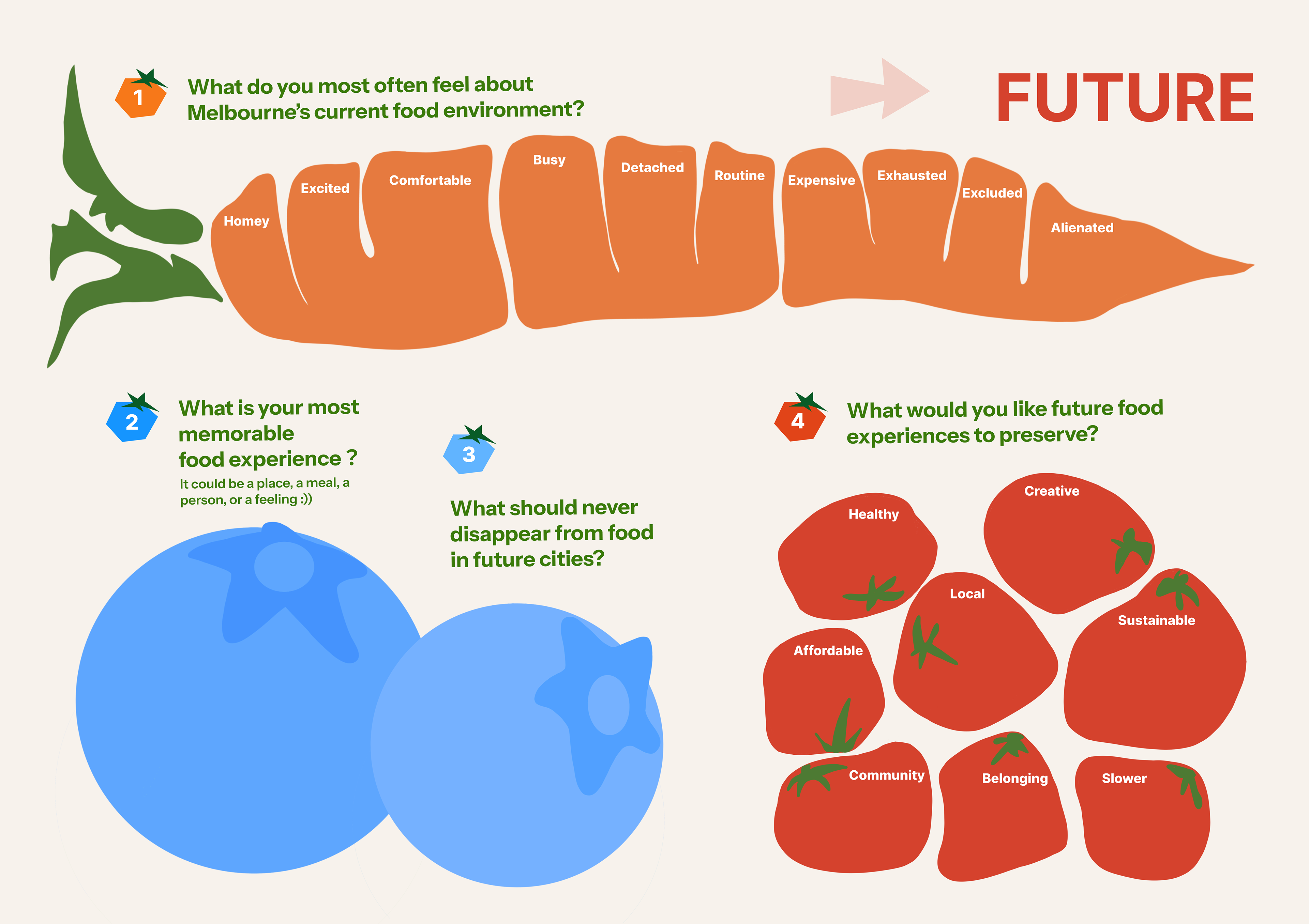
FIG 28. Future Poster

07 MELBOURNE DESIGN WEEK 2026
08 PROJECT TAKEAWAYS
Skillsets

You may also like

Back to Top